You signed in with another tab or window. Reload to refresh your session.You signed out in another tab or window. Reload to refresh your session.You switched accounts on another tab or window. Reload to refresh your session.Dismiss alert
Hi decode team. Thanks for your contribution to the SMLM field, this is a big step forward!
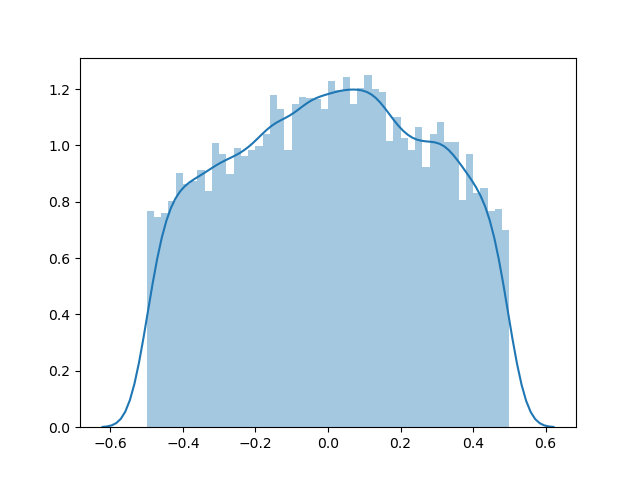
As for my question: I'm getting non-uniform y_offset values even after ~800 epochs, which I guess would bias localizations towards the center of pixels. Is there a loss parameter that can be tuned to remove this? I noticed neuralfitter/de_bias.py but it does not seem to be used anywhere.
Also, what is a typical number of epochs you use before you consider the network trained well enough? I could not find this mentioned in the tutorials/docs.
Hey, thank you very much, we hope you'll get good results with DECODE.
To your question: unfortunately, we were unable to achieve completely uniform offset variables for difficult imaging conditions.
We address the issue in the paper and offer some options to remove the resulting artifacts in Extended data Fig. 8: https://www.nature.com/articles/s41592-021-01236-x/figures/13
As you can see your distribution looks quite similar to the one in that example so the solutions should hopefully work well on your data.
I think the best method is the rendering with individual inferred Gaussians, we provide an example for this in our Fitting.ipynb example notebook. The second-best solution is to rem…
Hey, thank you very much, we hope you'll get good results with DECODE.
To your question: unfortunately, we were unable to achieve completely uniform offset variables for difficult imaging conditions.
We address the issue in the paper and offer some options to remove the resulting artifacts in Extended data Fig. 8: https://www.nature.com/articles/s41592-021-01236-x/figures/13
As you can see your distribution looks quite similar to the one in that example so the solutions should hopefully work well on your data.
I think the best method is the rendering with individual inferred Gaussians, we provide an example for this in our Fitting.ipynb example notebook. The second-best solution is to remove localizations with the highest uncertainties until no artifacts are visible in the reconstruction.
About the training length: In my experience something between 300-500 epochs usually suffices.
Thanks! Good to see that filtering on detection probability and uncertainty flattens it out almost completely.
Did you ever try to put some sort of histogram equalization term in the loss function or did this have other negative consequences?
I definitely played around with it but that was before we introduced the current loss function. So it might be worth another attempt.
If you want to try I'd be happy to assist.
reacted with thumbs up emoji reacted with thumbs down emoji reacted with laugh emoji reacted with hooray emoji reacted with confused emoji reacted with heart emoji reacted with rocket emoji reacted with eyes emoji
Hey, thank you very much, we hope you'll get good results with DECODE.
To your question: unfortunately, we were unable to achieve completely uniform offset variables for difficult imaging conditions.
We address the issue in the paper and offer some options to remove the resulting artifacts in Extended data Fig. 8: https://www.nature.com/articles/s41592-021-01236-x/figures/13
As you can see your distribution looks quite similar to the one in that example so the solutions should hopefully work well on your data.
I think the best method is the rendering with individual inferred Gaussians, we provide an example for this in our Fitting.ipynb example notebook. The second-best solution is to rem…