OpenAI Codex as an iii worker: the Codex API exposed as functions and streams on the iii bus, nothing else. The worker spawns the same codex binary the user runs in their terminal, with the same login (ChatGPT or API key), the same filesystem, and the same sandbox. codex::run executes one headless turn and returns the result; the raw Codex thread events mirror verbatim onto the codex::events stream, and a translated AgentEvent view lands on agent::events, so the iii console and any sibling worker observe a Codex run exactly like a native harness turn.
iii worker add codexRequires the Codex CLI on the host (npm i -g @openai/codex) and either an existing codex login or OPENAI_API_KEY in the worker environment.
Install the codex agent skill for Claude Code, Cursor, and 30+ other agents:
npx skills add iii-hq/workers --skill codexFrom zero to a Codex turn over the bus:
curl -fsSL https://install.iii.dev/iii/main/install.sh | sh
iii worker add codex
iii   # starts the engine + worker
Then talk to it like any other function: from iii trigger codex::run, or from any SDK:
import { registerWorker } from 'iii-sdk';

const iii = registerWorker('ws://127.0.0.1:49134', { workerName: 'demo' });

const res = await iii.trigger({
  function_id: 'codex::run',
  payload: {
    prompt: 'Add a /health endpoint to server.ts and run the tests',
    cwd: '/path/to/repo',
    sandbox_mode: 'workspace-write',
  },
  timeout_ms: 600_000,
});
// { session_id, codex_thread_id, result, stop_reason, usage }
Or straight from the terminal with the iii trigger CLI:
# one full turn (raise the timeout; the default 30s is too short for agent turns)
iii trigger codex::run --timeout-ms 600000 \
  --json '{"prompt":"add a /health endpoint and run the tests","cwd":"/path/to/repo"}'

# quick reads use key=value syntax
iii trigger codex::sessions::list
iii trigger codex::status session_id=<session_id>

# background turn + control
iii trigger codex::start --json '{"prompt":"...","cwd":"/path/to/repo"}'
iii trigger codex::stop session_id=<session_id>

# ask the running engine for a function's description and parameter table
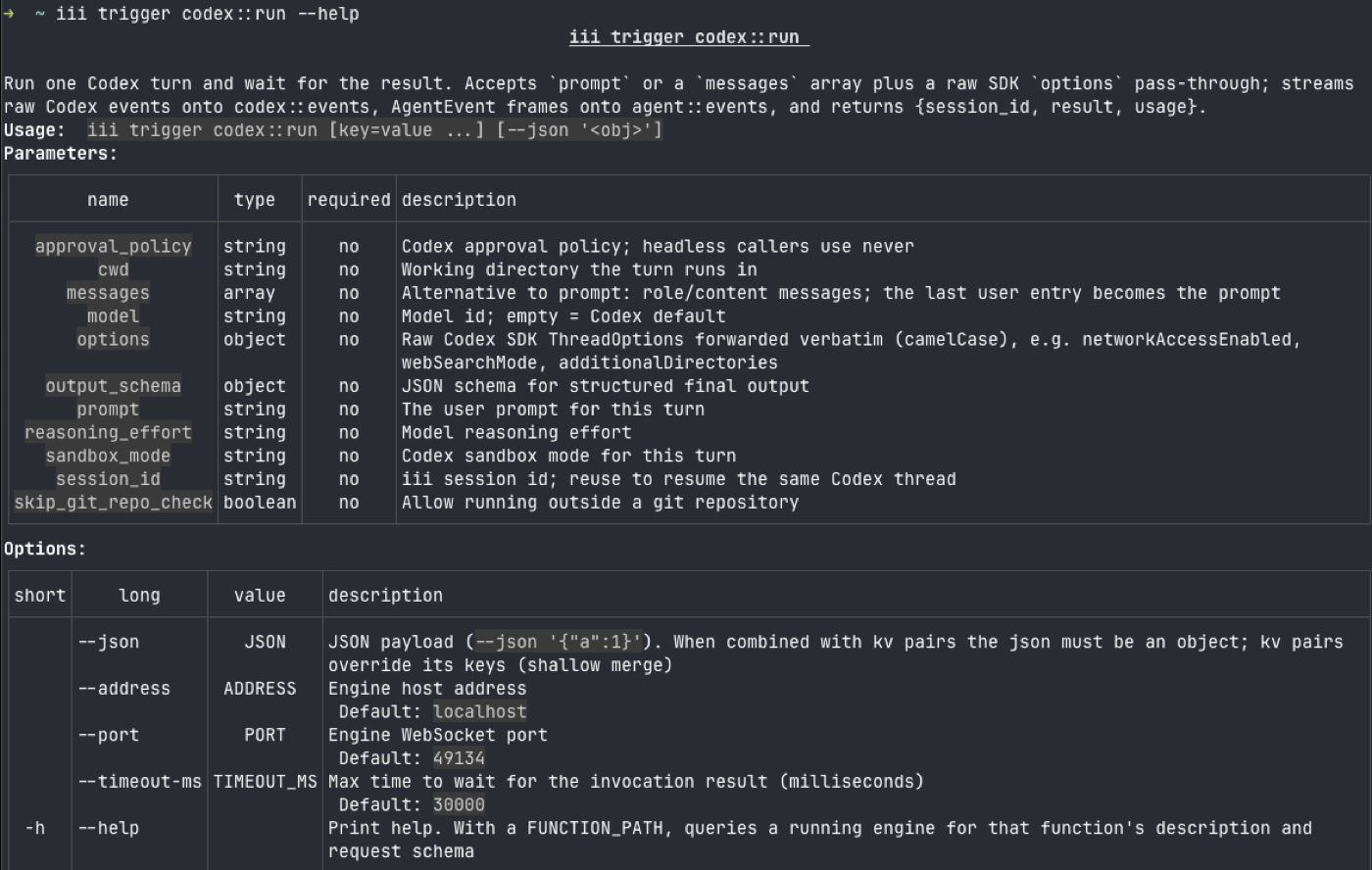
iii trigger codex::run --help
A turn from the CLI and the published schema:
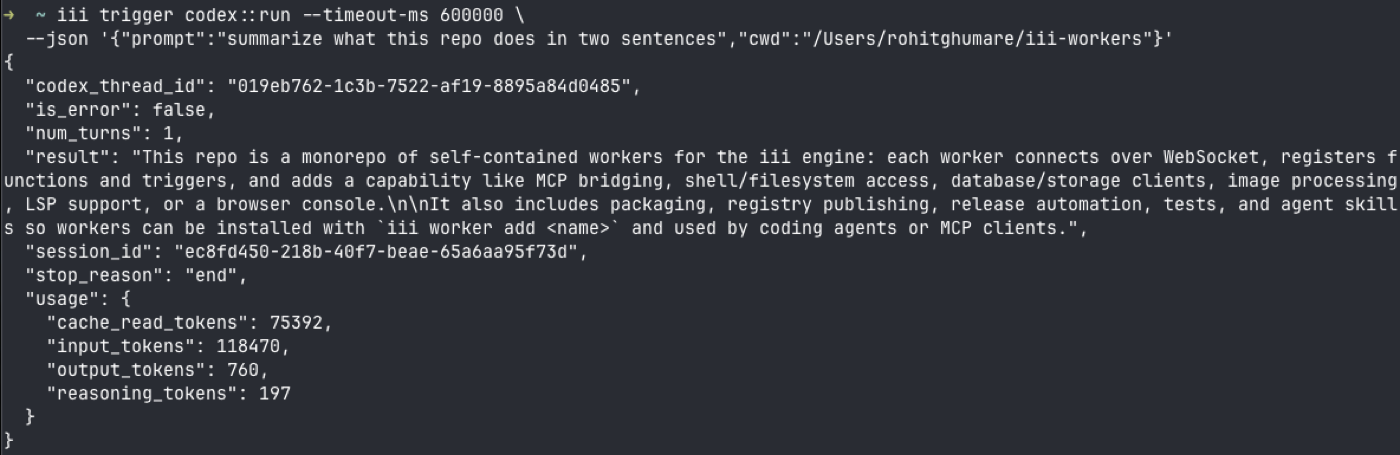
Call codex::run again with the returned session_id to continue the same conversation: the worker maps iii session ids to Codex thread ids in engine state and resumes automatically (threads persist in ~/.codex/sessions).
Two ids come back from every run. session_id is the iii session id: the key for codex::status, codex::stop, resume, and the stream group. codex_thread_id is Codex's internal thread id (what the worker passes to resumeThread under the hood) — returned for reference, not a lookup key.
| Function | Purpose |
|---|---|
codex::run |
Run one turn, wait, return the final result |
codex::start |
Fire-and-forget turn; progress arrives on the streams |
codex::stop |
Interrupt a live run |
codex::status |
Session state, live flag, usage |
codex::sessions::list |
All sessions this worker has run |
codex::run accepts either a bare prompt string or a messages array ([{ role: 'user', content: [{ type: 'text', text }] }]) — the same input contract as the claude-code worker and run::start_and_wait, so the acp worker drives Codex with --brain-fn codex::run — plus model, cwd, sandbox_mode, approval_policy, reasoning_effort, skip_git_repo_check, output_schema, images (local image paths), additional_directories (extra writable roots), and codex_config.
The worker drives the codex exec --json CLI, so anything the CLI exposes as a config.toml override goes through the codex_config field untouched — MCP servers, model providers, profiles, network access, web search, and the rest. Each key/value becomes a --config key=value on the spawn:
Extra writable directories use the named additional_directories field (the CLI's --add-dir).
And the full output side is available raw: every event Codex emits (thread.started, turn.started, item.started/updated/completed for commands, patches, MCP tool calls, web searches, reasoning, agent messages, turn.completed with usage, turn.failed) is mirrored verbatim onto the codex::events stream, group_id = session_id. Consumers that want the exact Codex wire format read codex::events; consumers that want harness-shaped frames read agent::events. Same turn, two views.
engine_url: ws://127.0.0.1:49134
defaults:
model: "" # empty = Codex default
sandbox_mode: workspace-write # read-only | workspace-write | danger-full-access
approval_policy: never # never | on-request | on-failure | untrusted
reasoning_effort: "" # empty = Codex default
cwd: "" # default working directory for runs
skip_git_repo_check: true
events_stream: agent::events # translated AgentEvent frames
raw_events_stream: codex::events # verbatim Codex thread events
codex_executable: "" # path to the codex CLI; empty = PATH resolutionSandboxing is Codex's own: read-only blocks writes, workspace-write allows edits inside cwd, danger-full-access disables the sandbox. approval_policy is forwarded to Codex per turn from the payload or the configured default; headless callers leave it at never so a command the sandbox blocks fails instead of prompting, but any other value is passed through and respected.
By default every turn carries the iii runtime context, delivered through Codex's native developer_instructions config (a developer-role message in the turn context, the channel Codex itself uses for standing instructions): the same engine-grounded rules as the harness identity prompts, retargeted to the iii CLI the agent reaches through its sandboxed shell. The agent discovers capabilities from the live engine instead of memory — iii trigger engine::functions::list to find function ids, iii trigger <fn> --help as the contract before every first call, the registry flow (directory::registry::workers::list/info, worker::add) when nothing registered fits — plus the calling rules and error-handling discipline that go with them. Local file edits stay on Codex's native tools; backend actions go through registered functions.
# the agent answers this by querying the live engine itself
iii trigger codex::run --timeout-ms 300000 \
--json '{"prompt":"List every worker connected to this engine and what each one does.","cwd":"/tmp"}'The block rides the turn context on every call, resumes included, without touching your prompt or Codex's base instructions. Turn it off per call with "iii_context": false or globally in config.yaml; a caller-supplied developer_instructions in codex_config wins over it.
Codex has no named plan mode; the equivalent is a planning prompt under the read-only sandbox. The guarantee is OS-level (Seatbelt on macOS, Landlock on Linux), so writes physically fail rather than being policy-declined. Because the worker resumes threads, plan-then-execute is two calls against the same session_id:
# 1. plan (OS-enforced read-only)
iii trigger codex::run --timeout-ms 600000 \
--json '{"prompt":"Plan how to add rate limiting to the REST API. Do not implement.","cwd":"/path/to/repo","sandbox_mode":"read-only"}'
# 2. execute the plan with full context, same thread
iii trigger codex::run --timeout-ms 600000 \
--json '{"session_id":"<from-step-1>","prompt":"Implement the plan.","sandbox_mode":"workspace-write","cwd":"/path/to/repo"}'The approval step is whatever sits between the two calls — a human reading the plan, another worker, or a trigger.
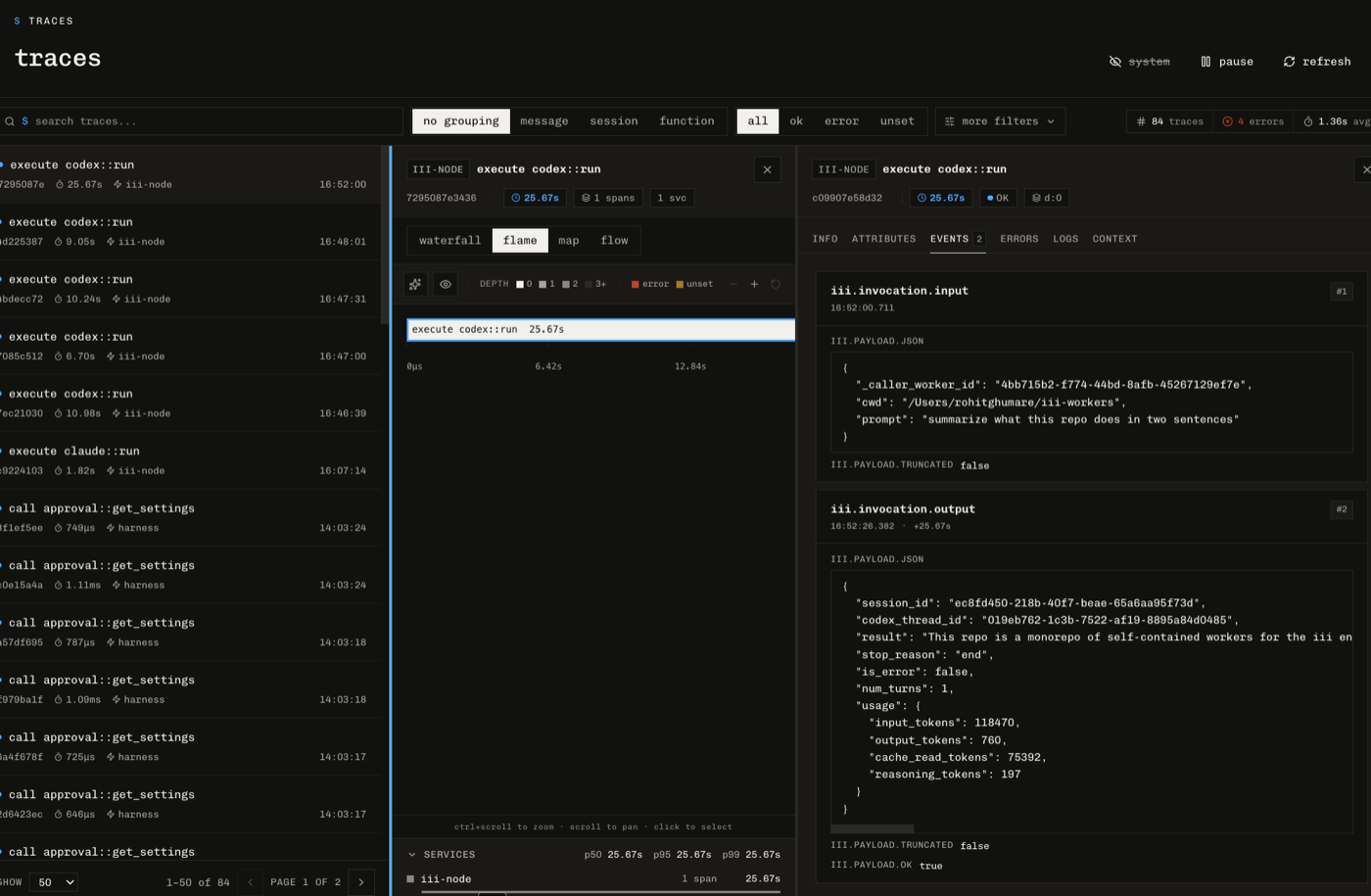
Every codex::run is an ordinary traced invocation on the engine: the trace carries the full input payload and the output (result, usage) as span events, with per-function p50/p95/p99 in the console's trace explorer — no extra instrumentation in the worker.
| Codex | iii |
|---|---|
SDK runStreamed() turn |
codex::run invocation |
| every thread event, verbatim | codex::events stream frame |
| agent_message / reasoning item | message_complete frame on agent::events |
| command_execution / file_change / mcp_tool_call / web_search | function_execution_start / function_execution_end frames |
| turn end | turn_end + agent_end frames, function return value |
| thread resume | engine state scope codex_sessions, keyed by iii session_id |
| extra capability | another iii worker on the bus (shell, database, storage, ...) |
{
  "prompt": "...",
  "codex_config": {
    "sandbox_workspace_write": { "network_access": true },
    "web_search": "live",
    "mcp_servers": { "github": { "command": "gh-mcp" } }
  }
}