Pi coding agent as an iii worker: the Pi API exposed as functions and streams on the iii bus, nothing else. The worker runs the same in-process agent loop Pi runs in the terminal, with the same tools (read, bash, edit, write) against any host directory. pi::run executes one headless turn and returns the result; the raw Pi events mirror verbatim onto the pi::events stream, and a translated AgentEvent view lands on agent::events, so the iii console, the acp worker, and any sibling worker observe a Pi run exactly like a native harness turn. The worker also registers run::start_and_wait, the same entrypoint the console and the acp worker drive, so both run Pi with no changes.
iii worker add piPi runs the loop in-process (no CLI subprocess), so the worker environment needs model credentials — ANTHROPIC_API_KEY (or the provider key Pi is configured for) or an existing Pi login.
Install the pi agent skill for Claude Code, Cursor, and 30+ other agents:
npx skills add iii-hq/workers --skill piFrom zero to a Pi turn over the bus:
curl -fsSL https://install.iii.dev/iii/main/install.sh | sh
iii worker add pi
iii   # starts the engine + worker
Then talk to it like any other function: from the console chat, from iii trigger pi::run, or from any SDK:
import { registerWorker } from 'iii-sdk';

const iii = registerWorker('ws://127.0.0.1:49134', { workerName: 'demo' });

const res = await iii.trigger({
  function_id: 'pi::run',
  payload: {
    prompt: 'Add a /health endpoint to server.ts and run the tests',
    cwd: '/path/to/repo',
  },
  timeout_ms: 600_000,
});
// { session_id, pi_session_id, result, stop_reason, usage, total_cost_usd }
Or straight from the terminal with the iii trigger CLI:
# one full turn (raise the timeout; the default 30s is too short for agent turns)
iii trigger pi::run --timeout-ms 600000 \
  --json '{"prompt":"add a /health endpoint and run the tests","cwd":"/path/to/repo"}'

# quick reads use key=value syntax
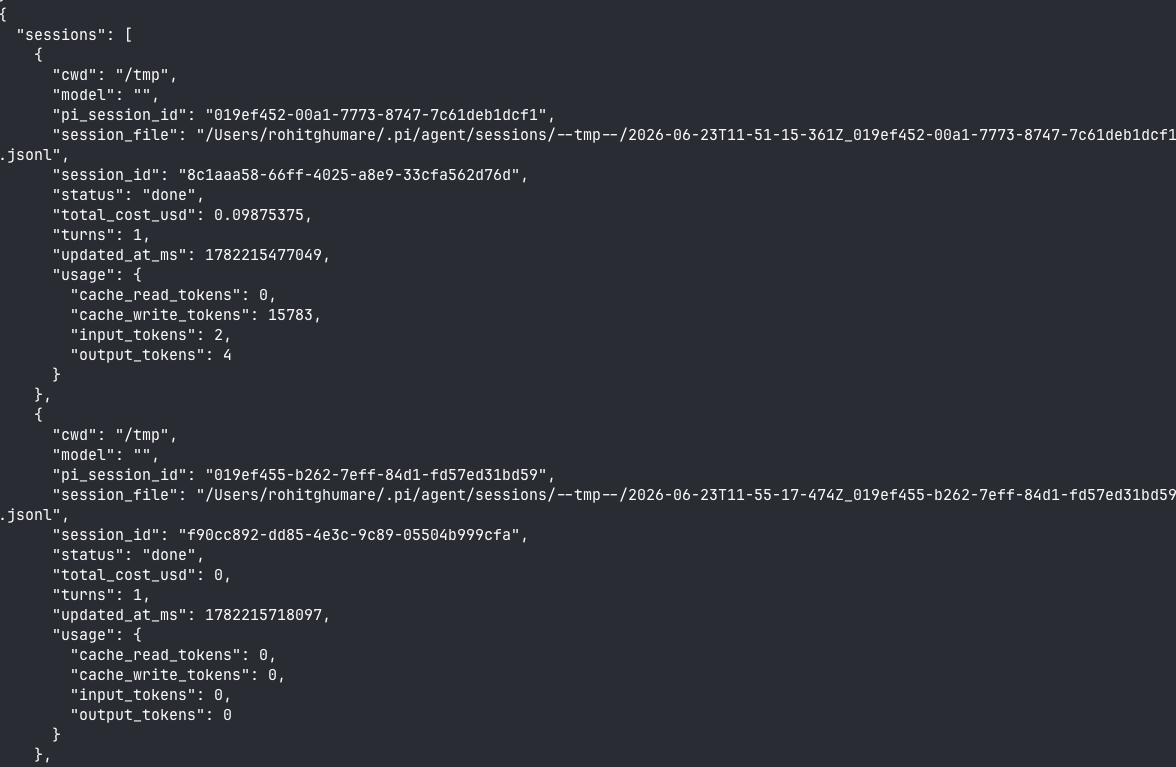
iii trigger pi::sessions::list
iii trigger pi::status session_id=<session_id>

# background turn + control
iii trigger pi::start --json '{"prompt":"...","cwd":"/path/to/repo"}'
iii trigger pi::stop session_id=<session_id>

# ask the running engine for a function's description
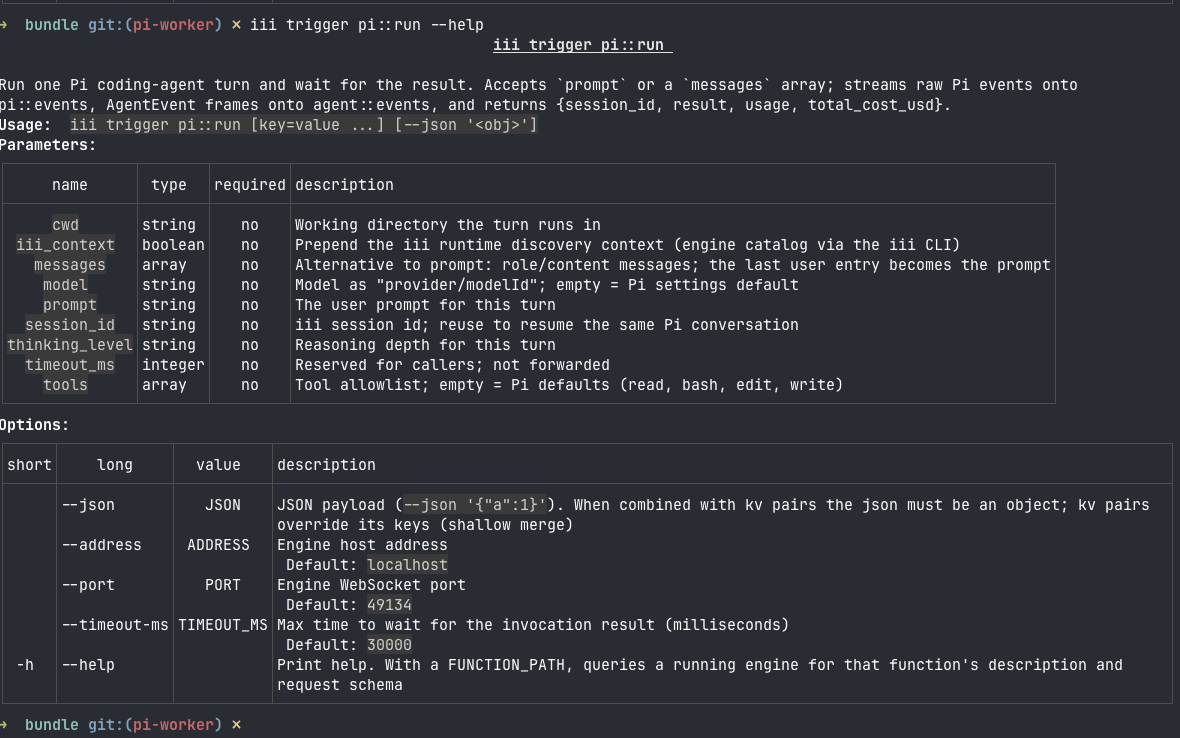
iii trigger pi::run --help
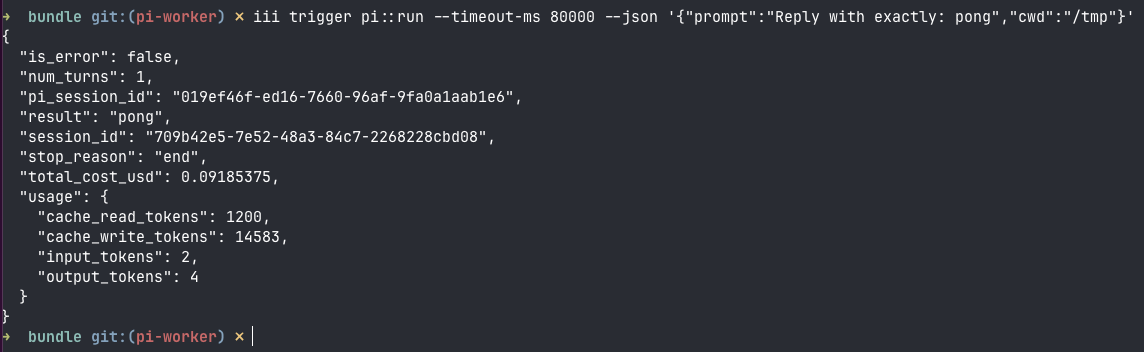
A turn from the CLI returns the result with token usage and cost:
iii trigger pi::run --help prints the published request schema as a parameter table:
Call pi::run again with the returned session_id to continue the same conversation: the worker maps iii session ids to Pi session files in engine state and resumes automatically.
Two ids come back from every run. session_id is the iii session id: the key for pi::status, pi::stop, pi::steer, resume, and the stream group. pi_session_id is Pi's internal session id — returned for reference, not a lookup key.
Long turns: use pi::start to return immediately, then watch agent::events (group_id = your session_id) for message_complete, function_execution_start/end, and turn_end frames. pi::stop interrupts a live run, pi::status reads a point-in-time view, pi::sessions::list enumerates past sessions.
| Function | Purpose |
|---|---|
pi::run |
Run one turn, wait, return the final result |
pi::start |
Fire-and-forget turn; progress arrives on agent::events |
pi::steer |
Inject a steering instruction into a live run |
pi::follow_up |
Queue a follow-up message for a live run |
pi::stop |
Interrupt a live run |
pi::status |
Session state, live flag, usage, cost |
pi::sessions::list |
All sessions this worker has run |
run::start_and_wait |
Alias for pi::run under the entrypoint the console and acp worker drive |
pi::run accepts either a bare prompt string or a messages array ([{ role: 'user', content: [{ type: 'text', text }] }]), plus model, cwd, thinking_level, tools, and iii_context overrides.
Every event Pi emits (agent_start/end, turn_start/end, message_start/update/end, tool_execution_start/update/end, and the session events queue_update, compaction_start/end) is mirrored verbatim onto the pi::events stream, group_id = session_id. Consumers that want the exact Pi event format read pi::events; consumers that want harness-shaped frames read agent::events. Same turn, two views.
A turn started with pi::start keeps its session reachable while it streams. Two functions push instructions into it:
# start a long run
iii trigger pi::start --json '{"prompt":"refactor the auth module","cwd":"/path/to/repo","session_id":"s1"}'

# redirect it mid-flight — applied after the current tool calls finish
iii trigger pi::steer --json '{"session_id":"s1","prompt":"stop, keep the public API unchanged"}'

# queue work for after it would otherwise stop
iii trigger pi::follow_up --json '{"session_id":"s1","prompt":"then add tests for the new paths"}'
pi::steer maps onto Pi's steering queue (interrupt-style), pi::follow_up onto its follow-up queue (wait-style). Both no-op with {steered:false} / {queued:false} when no run is live for the session.
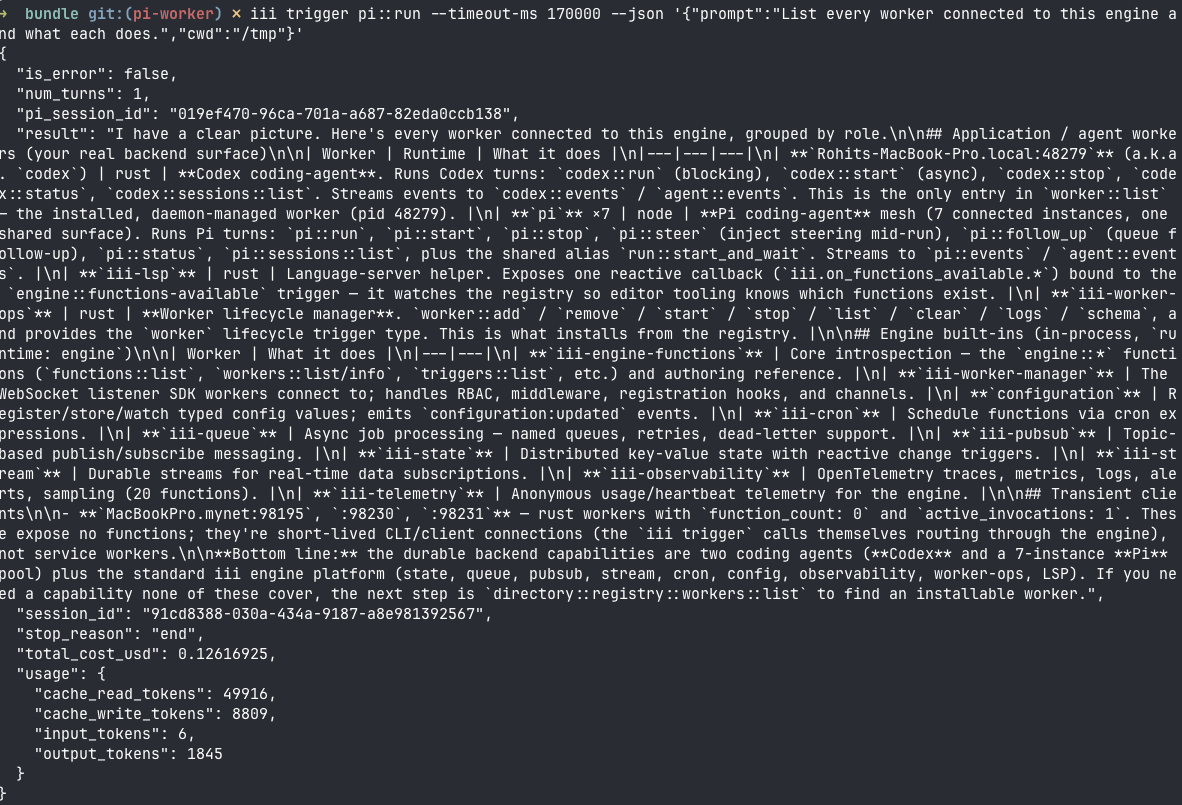
By default every turn's prompt carries the iii runtime context: the same engine-grounded rules as the harness identity prompts, retargeted to the iii CLI the agent reaches through its shell. The agent discovers capabilities from the live engine instead of memory — iii trigger engine::functions::list to find function ids, iii trigger <fn> --help as the contract before every first call, the registry flow (directory::registry::workers::list/info, worker::add) when nothing registered fits — plus the calling rules and error-handling discipline that go with them. Local file edits stay on Pi's native tools; backend actions go through registered functions.
# the agent answers this by querying the live engine itself
iii trigger pi::run --timeout-ms 300000 \
  --json '{"prompt":"List every worker connected to this engine and what each one does.","cwd":"/tmp"}'
Pi answers by querying the live engine itself, grouping every connected worker by role:
The context is prepended on a fresh session and skipped on resume (it is already in the conversation history). Turn it off entirely with "iii_context": false per call or globally in config.yaml.
thinking_level maps straight onto Pi's reasoning levels, per turn:
| Level | Behavior |
|---|---|
off |
No extended reasoning |
minimal / low |
Short reasoning budget |
medium |
The worker default |
high / xhigh |
Deep reasoning (xhigh on supported model families) |
tools is an allowlist: leave it empty for Pi's defaults (read, bash, edit, write), or pass a subset to narrow what the turn can do — e.g. {"tools":["read","bash"]} for a read-and-run turn that cannot edit or write files.
engine_url: ws://127.0.0.1:49134

defaults:
  model: ""                # empty = Pi settings default; else "provider/modelId"
  thinking_level: medium   # off | minimal | low | medium | high | xhigh
  cwd: ""                  # default working directory for runs
  tools: []                # empty = Pi defaults (read, bash, edit, write)
  agent_dir: ""            # Pi global config dir; empty = ~/.pi/agent

events_stream: agent::events   # translated AgentEvent frames
raw_events_stream: pi::events  # verbatim Pi events
iii_context: true              # prepend the iii runtime context on fresh sessions
config.yaml is the seed: on first boot the worker registers it with the built-in configuration worker as the initial value, then reads the live value back and hot-reloads on every configuration:updated. engine_url is excluded from the managed schema — it is bootstrap, so it stays on the local seed / --url.
Every pi::run is an ordinary traced invocation on the engine: the trace carries the full input payload (prompt, cwd, caller worker id) and the output (result, stop reason, token usage, cost) as span events, with per-function p50/p95/p99 in the console's trace explorer — no extra instrumentation in the worker.
| Pi | iii |
|---|---|
AgentSession.prompt() turn |
pi::run invocation |
| every AgentSession event, verbatim | pi::events stream frame |
assistant message_end |
message_complete frame on agent::events |
tool_execution_start / tool_execution_end |
function_execution_start / function_execution_end frames |
| final result | turn_end + agent_end frames, function return value |
steer() / followUp() |
pi::steer / pi::follow_up |
| session resume | engine state scope pi_sessions, keyed by iii session_id |
| extra capability | another iii worker on the bus (shell, database, storage, ...) |