Manage localization resources with real-time validation, translation, and code scanning. Supports .resx, JSON, i18next, Android strings.xml, and iOS .strings formats.
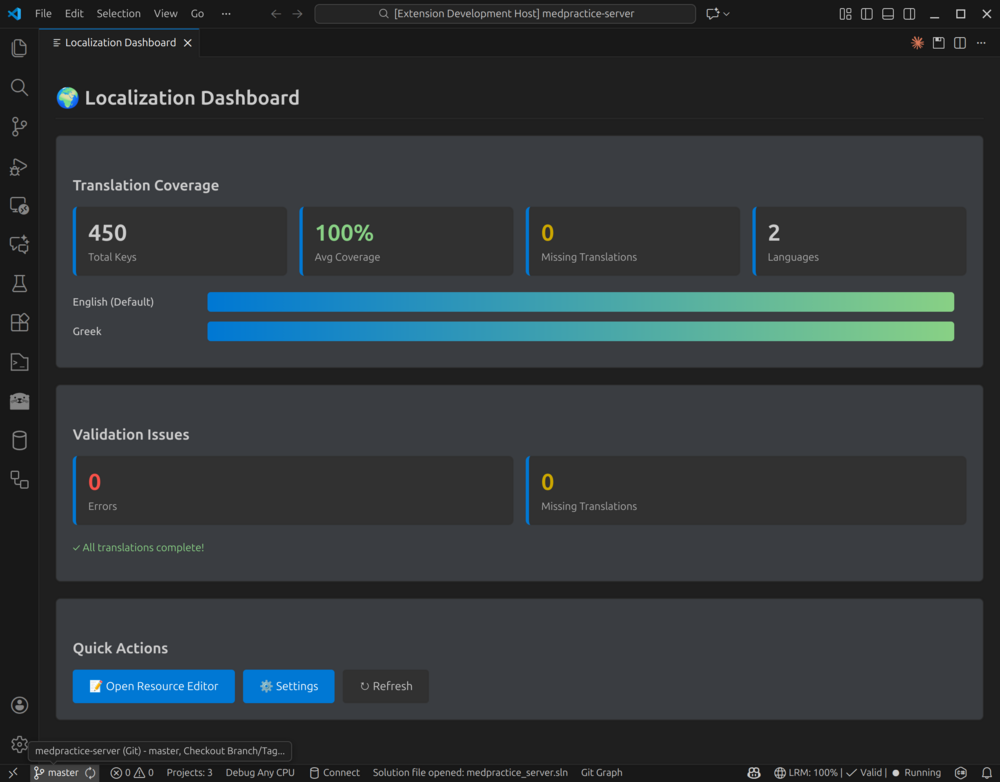
View translation coverage, validation issues, and quick actions at a glance.
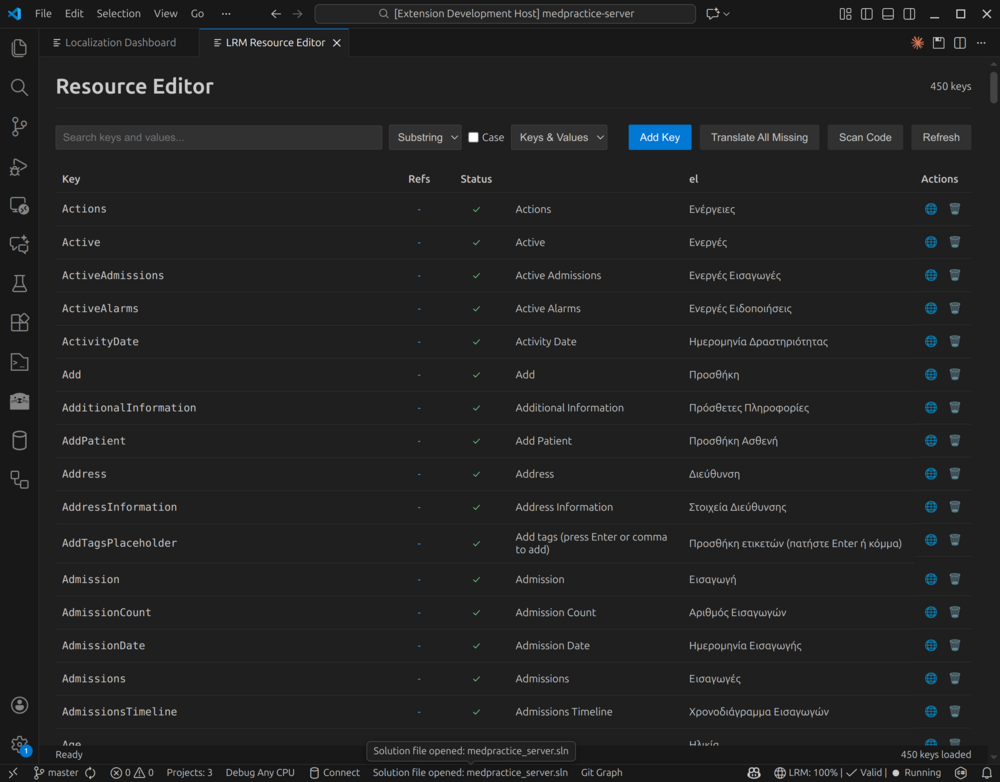
Edit all languages side-by-side with search, filtering, and bulk actions.
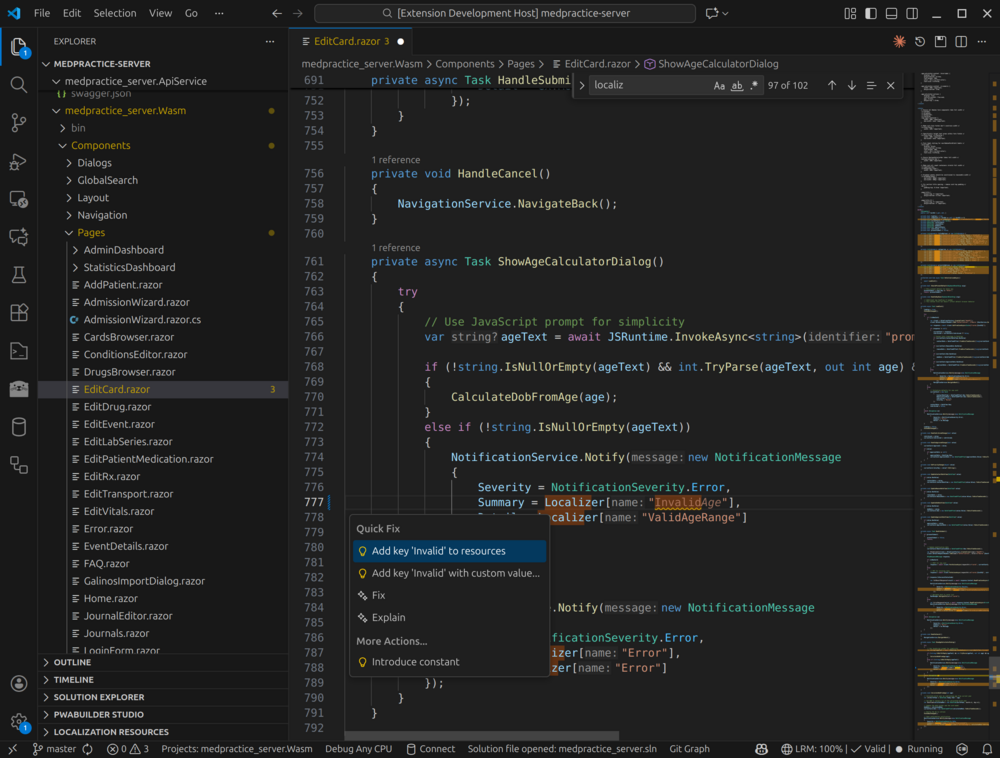
Get inline warnings for missing localization keys as you type.
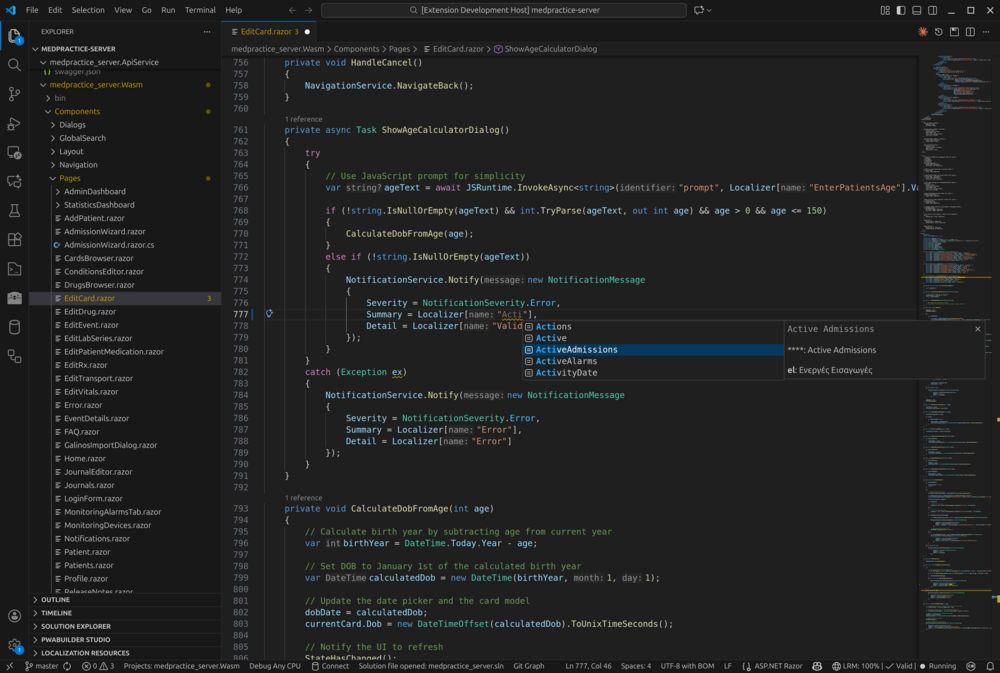
Get autocomplete suggestions for localization keys as you type. Supports Resources., GetString(", _localizer[" and more patterns.
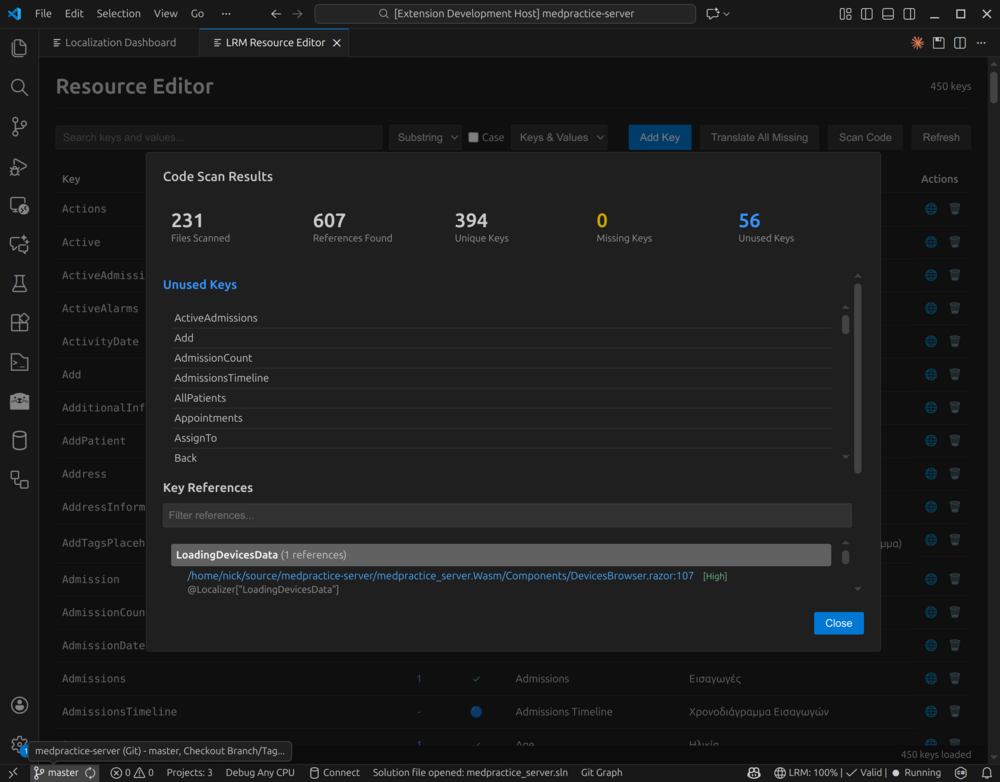
Find missing and unused keys across your codebase.
Get inline information and actions directly in your code.
In resource files (.resx and .json, above each key):
- Reference count (e.g., "12 references") - click to see all usages
- Language coverage (e.g., "3/5 languages") - click to see missing translations
- Quick translate action
- Warnings for unused or duplicate keys
In code files (.cs, .razor, .xaml, .cshtml):
- Key value preview (e.g., "Welcome to our app")
- Missing language warnings - click to translate
- Click to open the key in Resource Editor
Works with all major localization formats:
- .resx: .NET resource files (
Resources.resx,Resources.fr.resx) - JSON: Standard JSON (
strings.json,strings.fr.json) - i18next: React/Vue/Angular (
en.json,fr.json) with nested keys - Android:
res/values/strings.xml,res/values-es/strings.xml - iOS:
en.lproj/Localizable.strings,es.lproj/Localizable.strings
Auto-detects format based on file naming and folder structure.
Press F12 on any localization key in code to jump directly to its definition in the resource file.
- Supports:
Resources.KeyName,Localizer["Key"],t("Key"), and more patterns
Press Shift+F12 to find all usages of a key across your codebase and resource files.
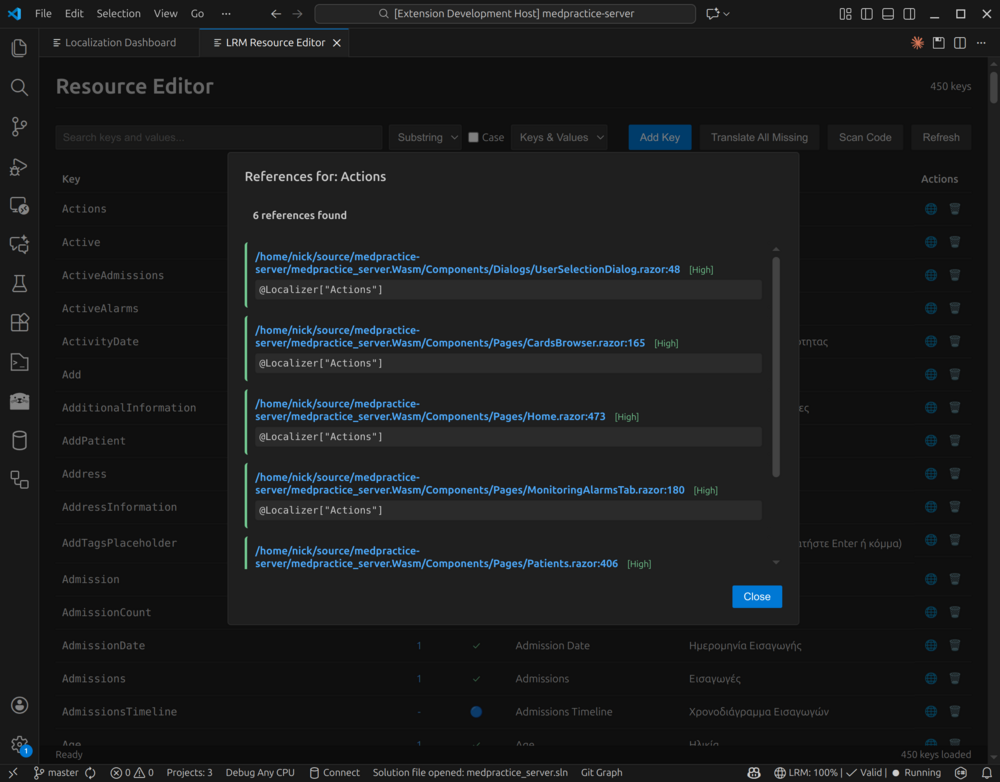
See exactly where each key is used in your code.
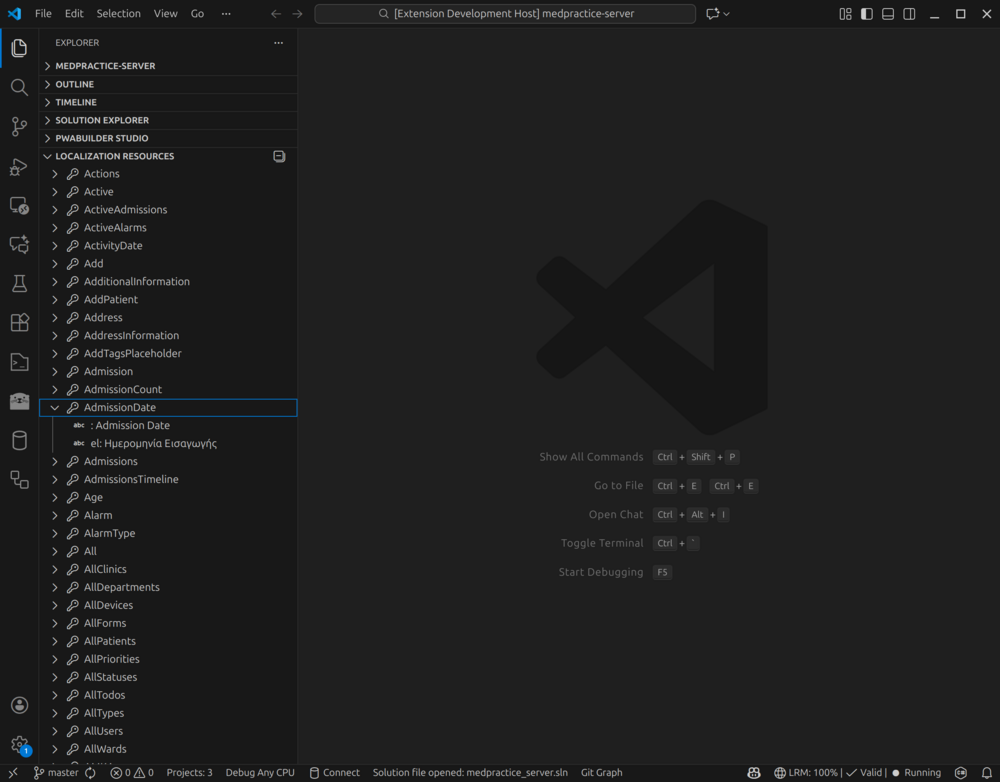
Browse keys organized by resource file in the Explorer sidebar.
Translate missing values using free or paid providers.
- Free (no API key): Lingva, MyMemory
- Free (local AI): Ollama - run AI translation locally, completely free and private
- Paid: Google, Azure, AWS, DeepL, OpenAI, Anthropic
- VS Code 1.80+
- Workspace with localization files (.resx, .json, Android strings.xml, or iOS .strings)
- Install the extension
- Open a workspace containing localization files (.resx, JSON, Android, or iOS)
- The extension auto-detects resources (if multiple formats found, you'll be asked to choose)
- Use Command Palette (Ctrl+Shift+P) → "LRM:" commands
| Command | Description |
|---|---|
| LRM: Open Dashboard | View coverage and validation status |
| LRM: Open Resource Editor | Edit resources in web UI |
| LRM: Validate Resources | Check for issues |
| LRM: Scan Code | Find missing/unused keys |
| LRM: Add Key | Add new localization key |
| LRM: Translate Missing Values | Auto-translate |
| LRM: Set Resource Path | Configure resource location |
| Setting | Description | Default |
|---|---|---|
lrm.resourcePath |
Path to resource folder | Auto-detected |
lrm.translationProvider |
Default provider | mymemory |
lrm.enableRealtimeScan |
Live diagnostics | true |
lrm.scanOnSave |
Scan on file save | true |
lrm.enableCodeLens |
Show CodeLens annotations | true |
lrm.codeLens.showReferences |
Show reference count | true |
lrm.codeLens.showCoverage |
Show language coverage | true |
lrm.codeLens.showTranslate |
Show translate action | true |
lrm.codeLens.showValue |
Show key value in code | true |
LRM stores configuration in two places:
Extension-specific settings stored in VS Code workspace settings:
- Resource path, scanning options, file type filters
- These are VS Code-only and don't affect CLI usage
Shared configuration file for both VS Code extension and CLI:
- Translation provider settings, AI model configurations
- Scanning patterns, validation rules
- Located in your resource folder
API keys can be configured in three ways (in priority order):
| Method | Security | Shared with CLI |
|---|---|---|
| Environment Variables | High | Yes |
| Secure Credential Store | High (AES-256 encrypted) | Yes |
| lrm.json | Low (plain text) | Yes |
export LRM_GOOGLE_API_KEY="your-key"
export LRM_OPENAI_API_KEY="your-key"
export LRM_DEEPL_API_KEY="your-key"API keys are encrypted with AES-256 and stored locally:
- Windows:
%LOCALAPPDATA%\LocalizationManager\credentials.json - Linux:
~/.local/share/LocalizationManager/credentials.json - macOS:
~/.local/share/LocalizationManager/credentials.json
Enable in Settings panel or via CLI:
lrm config set-api-key --provider google --key "your-key"The encryption uses machine-specific keys, so credentials cannot be copied between machines.
{
  "Translation": {
    "ApiKeys": {
      "Google": "your-key-here"
    }
  }
}Warning: Add
lrm.jsonto.gitignoreif storing API keys in plain text.
Use LRM: Open Settings to configure:
- Translation providers and API keys
- AI model settings (OpenAI, Claude, Ollama, etc.)
- Code scanning patterns
- Validation rules
The Settings panel shows where each API key is configured (environment, secure store, or config file) and allows testing provider connections.
- Backend won't start: Check "LRM Backend" output channel
- Resources not detected: Use "LRM: Set Resource Path"
- Translation fails: Free providers need no setup; paid need API keys
See CHANGELOG
MIT - Nikolaos Protopapas