The multi-paradigm database expert for Claude Code.
Design a new schema, audit an existing one on two independent axes — Design & Integrity and Performance & Scale — and optionally plan the safe migration for you.




-2ea44f.svg)
Two scores, never blended. A schema can be impeccably modeled yet collapse under load, or scream fast yet silently corrupt your data.
claude-dbmeasures Design & Integrity and Performance & Scale separately and tells you exactly what to fix on each.
🇪🇸 Resumen en español al final · README completo en README.es.md · guías en docs/es/.
Most database tooling does one thing: a linter checks style, an EXPLAIN tab shows one query, an ORM hides the schema entirely. None of them sit a senior DBA next to you who can read your schema.prisma or live catalog, reason across modeling, integrity, indexing, concurrency, and migration safety at once, and weigh the trade-offs for your paradigm — relational, document, key-value, wide-column, vector, time-series, or graph.
claude-db is that reviewer. It is honest by construction: every finding ships with observed evidence and a runnable verification command, magnitudes are banded (high/medium/low), and it never fabricates a latency number, a row count, or a price. When a check genuinely needs a live database, it says needs_api — never a silent pass.
Original work, MIT-licensed — inspired by the patterns of community database tooling but copying no branding, text, or names from any other project.
As a Claude Code plugin (recommended):
/plugin marketplace add Hainrixz/claude-db
/plugin install claude-db@claude-db
/reload-plugins
Cross-agent (Cursor, Codex, Gemini CLI, Windsurf…) via Vercel Skills:
npx skills add Hainrixz/claude-db
The plugin works fully offline (Tier 0, no keys) against your schema/migration/ORM files or a plain-language description. See Data tiers for opt-in live introspection.
/claude-db:start                                           # ← start here: a no-jargon wizard (no files needed)
/claude-db:design   "<what you're building>" [--scale small|medium|large]   # recommend an engine + draft a schema + diagram
/claude-db:audit    "<path|$DATABASE_URL>" [--paradigm auto|…] [--tier 0|1|2]  # two scores + prioritized findings (read-only)
/claude-db:explain  "<path|table|finding-id>" [--query "<SQL>"]             # plain-language explainer / why-is-this-slow
/claude-db:migrate  "<migration-file>"  |  "<from-schema>" "<to-schema>"     # lint a migration, or diff two schemas → migration
/claude-db:fix      "<path>" [--category keys|indexing|constraints|migration|…] [--dry-run]   # opt-in, per-change confirm
/claude-db:next     "[findings.json]"                      # coach: the single highest-leverage fix, ranked
/claude-db:score    "[findings.json]" [--paradigm …]       # recompute the two scores
/claude-db:seed     "<path>" [--rows N]                    # generate FK-aware sample/seed data for a schema
/claude-db:checklist "<path|$DATABASE_URL>"                # production-readiness go/no-go grid
audit, explain, score, next, and checklist are read-only and never touch your files or write to your database. fix previews diffs by default and writes only after you confirm each change; destructive migrations require typing the object name back. First time? Run /claude-db:start — it asks 7 plain questions and recommends what to build. Power users can call any module directly, e.g. /claude-db:db-indexing.
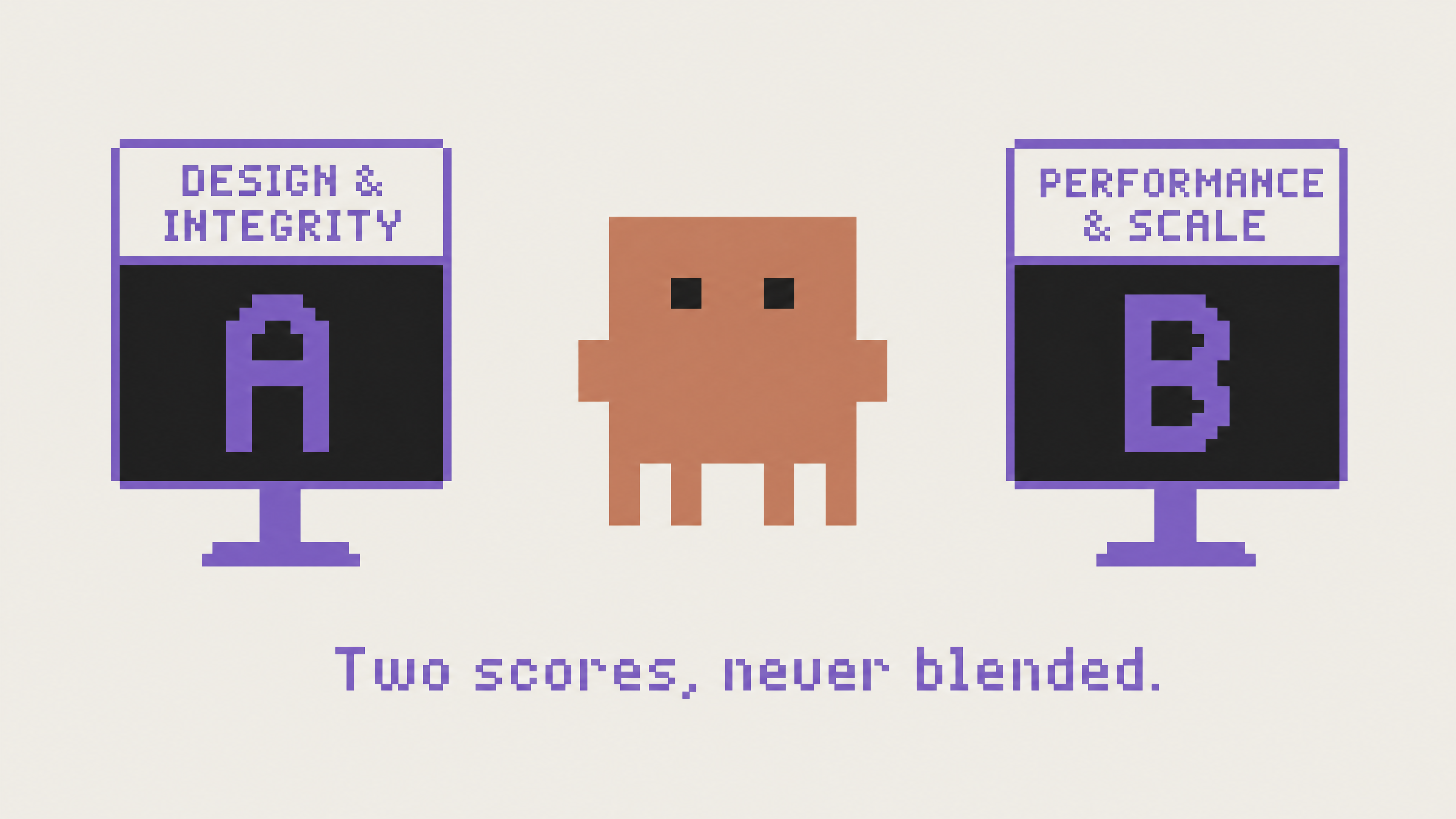
Every audit reports two 0–100 scores with letter bands (A–F) and a one-line interpretation (details):
- Design & Integrity — modeling, keys, referential integrity, types/precision, constraints, naming, security/access, temporal/lifecycle.
- Performance & Scale — indexing, index hygiene, query patterns, concurrency, pooling, partitioning/replicas, storage/operability, migration safety.
A finding declares its axis (design | performance | both) and feeds the category that owns its module in each axis independently — no double counting, no averaging. Severity gating caps a score at F if a severity:5 failure lands on that axis (e.g. a table with no primary key, RLS off on PII, TXID-wraparound risk). The detected paradigm swaps the category weights, so a document store is never penalized for lacking foreign keys, and needs_api checks are excluded from the math and counted separately as score confidence.
A skill-first, three-layer design (Claude is the runtime; the Node/Python helpers are optional):
- Directive — one of the command skills (
start/design/audit/explain/migrate/fix/next/score/seed/checklist). - Orchestration —
db-orchestratordetects the stack and paradigm, builds a shared schema snapshot, and dispatches read-only specialist auditors in parallel, then merges findings and runsscore.mjs. - Execution — focused
db-*modules (M0–M22) each emit findings conforming toschema/finding.schema.json— with observed evidence and a runnableverification.reproduce. Seedocs/en/architecture.md.
A complete suite of 23 modules (M0 advisory; M1–M22 scored), each feeding the design, performance, or both axis:
| Module | M | Axis | Checks |
|---|---|---|---|
db-engine-selection |
M0 | — | engine/paradigm recommendation for a new project (advisory, not scored) |
db-normalization |
M1 | design | 1NF–3NF, deliberate denormalization |
db-keys |
M2 | both | PK strategy (UUIDv7/ULID/bigint), no-PK (sev5), int4 exhaustion |
db-referential-integrity |
M3 | both | FKs, ON DELETE, cycles (sev4), composite FKs |
db-types-precision |
M4 | design | money=numeric/Decimal (float=sev5), timestamptz/UTC, jsonb-as-schema-evasion, enum vs lookup, utf8mb4 |
db-constraints |
M5 | design | NOT NULL, CHECK, UNIQUE (incl. over-nullable trap) |
db-defaults-generated |
M6 | design | defaults, generated/computed columns |
db-naming |
M7 | design | naming consistency & conventions |
db-temporal-history |
M8 | design | soft-delete, audit trail, retention / GDPR erasure |
db-multitenancy |
M9 | both | tenant isolation, tenant_id-leading index |
db-security-access |
M10 | design | RLS off (sev5), PII, encryption at-rest/TLS (sslmode=disable sev4), injection |
db-indexing |
M11 | perf | composite ESR, covering/partial, GIN/GiST/BRIN, FK-no-index, FTS/geo/JSONB |
db-index-hygiene |
M12 | perf | duplicate / redundant / unused indexes |
db-query-patterns |
M13 | perf | SELECT *, structural N+1, OFFSET vs keyset, non-SARGable |
db-concurrency |
M14 | perf | isolation, lost-update, SKIP LOCKED, idempotency |
db-connection-pooling |
M15 | perf | serverless + direct-PG, transaction-mode pooler |
db-partitioning-sharding |
M16 | perf | declarative partitioning, hot-partition, premature sharding |
db-replicas-views |
M17 | perf | read-your-writes, materialized-view refresh |
db-storage-bloat |
M18 | perf | VACUUM, TXID wraparound (sev5), tombstones |
db-antipatterns |
M19 | both | unified anti-pattern catalog (inherits the natural module's category) |
db-specialized-fit |
M20 | both | vector (dims/metric/HNSW), time-series/OLAP, graph, search |
db-platform-fit |
M21 | both | version currency (no fabricated EOL), pricing/lock-in honesty, per-platform FK support |
db-migration-safety |
M22 | perf | reversibility, lock level, table rewrite, destructive ops, enum mutation, schema drift |
claude-db detects the paradigm from your stack and swaps the scoring profile so each axis still sums to 100 with only the categories that apply (weights):
- Relational (Postgres, MySQL, SQLite, SQL Server) — the base profile.
- Document (MongoDB, Firestore) — access-pattern & embedding, doc-growth / 16MB, shard key.
- Key-value (Redis, DynamoDB) — access-pattern & key, idempotency, hot-partition, throughput.
- Wide-column (Cassandra, ScyllaDB) — table-per-query, partition sizing, tombstones.
- Vector (pgvector, Pinecone, Qdrant) — metric & dimension, index params, filtered search, recall-vs-latency.
- Time-series (TimescaleDB, ClickHouse) — hypertable fit, retention, continuous aggregates, compression.
- Graph (Neo4j) — edge modeling, traversal, supernode, index-lookup.
When more than one datastore is detected, each top-level score is the worst-of across stores per axis, with the per-store breakdown rendered beneath and the flooring store named.
| Tier | Needs | Adds |
|---|---|---|
| 0 (default) | nothing | full offline audit of schema/migration/ORM files or a plain-language description |
| 1 | a read-only $DATABASE_URL or a database MCP |
live catalog introspection — real index inventory, FK-without-index, RLS state, engine version |
| 2 | runtime stats (pg_stat_statements, pg_stat_user_*, EXPLAIN ANALYZE) |
real plans, genuinely unused indexes, dead tuples, wraparound age, hot partitions |
Tier 0 produces established/directional findings from generated artifacts and best-effort findings (capped at directional) from program source. Higher tiers upgrade affected findings to established. The Tier-1 connection is read-only by contract (default_transaction_read_only=on, statement_timeout, only SELECT/EXPLAIN/catalog reads), backed by a PreToolUse hook. See references/data-tiers.md.
This tool refuses to ship database folklore:
- No fabricated numbers — never invents latency, throughput, row counts, table sizes, EOL dates, or prices, in findings or design recommendations. Magnitude is banded high / medium / low only.
needs_api, never a silent pass — a check that needs a live DB it doesn't have says so, and is excluded from the score and counted as confidence.- Confidence tiers on every finding —
established(durable fact or Tier-1/2-backed — can cap a score),directional(strong static signal),speculative(inference without live data — never caps, never a naked percentage). - Read-only by default — auditors are read-only by tool allowlist; only the one writer subagent (
db-migration-writer) can write, only via/claude-db:fix, and only after you confirm each diff. - Paradigm-fair — relational-only categories are dropped from NoSQL profiles, so a document/KV/graph store is never penalized for a relational concept it doesn't have.
The fixer (skills/fix) is disable-model-invocation: true — Claude can never trigger writes on its own. Only /claude-db:fix does, and only db-migration-writer has Write/Edit. It generates reversible, lock-aware migration files (concurrent index builds, NOT VALID + VALIDATE constraint splits, expand/contract column changes), previews a unified diff, refuses a dirty git tree, and never writes to .git, secrets, or lockfiles. Destructive operations (drops, type rewrites, enum mutations) are surfaced as advisory and never auto-applied.
.claude-plugin/   plugin.json + marketplace.json
skills/           10 command skills (start, design, audit, explain, migrate, fix, next, score, seed, checklist) + 3 orchestration (db-orchestrator, stack-detect, introspect)
                  + audit modules M0–M22 (db-*)
agents/           read-only auditors + 1 writer (db-migration-writer)
hooks/            PreToolUse write/read-only guard
scripts/          zero-dep helpers: detect-stack, parse-schema (.mjs), parse-orm-python.py, score.mjs, lib/util.mjs
references/        scoring model, detection signals, data tiers
schema/           finding + audit-report JSON Schemas
docs/en, docs/es  bilingual guides
tests/fixtures    sample schemas for verification
The skills work as pure Markdown; the zero-dependency helpers in scripts/ sharpen accuracy and make verification.reproduce runnable (Node ≥ 18, Python 3.10+, no install step):
node scripts/detect-stack.mjs   --path .
node scripts/parse-schema.mjs   --file schema.sql
python scripts/parse-orm-python.py --file models.py
node scripts/score.mjs          --findings findings.json
node tests/run.mjs # self-test over the fixturesBuilt by Enrique Rocha — I help teams ship data infrastructure and AI: consulting, automations, and agents. This is a community, MIT-licensed project: use it, fork it, open issues and PRs (see CONTRIBUTING.md).
- 🌐 tododeia.com
- 📸 Instagram @soyenriquerocha
MIT · Claude mascot artwork generated for this project in pixel-art style.
claude-db es la herramienta open-source de diseño, auditoría y migración de bases de datos para Claude Code. Audita cualquier base en dos puntajes independientes — Diseño e Integridad y Rendimiento y Escala — con hallazgos reproducibles, y opcionalmente planifica la migración segura por ti (reversible, consciente del nivel de bloqueo), siempre con confirmación previa.
- Instalar:
/plugin marketplace add Hainrixz/claude-db→/plugin install claude-db@claude-db. Cross-agente:npx skills add Hainrixz/claude-db. - Usar:
/claude-db:start·:design·:audit·:explain·:migrate·:fix·:next·:score·:seed·:checklist(vista previa por defecto; nunca escribe sin tu confirmación). - Multi-paradigma: relacional, documento, clave-valor, columna-ancha, vectorial, series de tiempo y grafo — el perfil de puntaje se adapta para que un store de documentos nunca se penalice por no tener llaves foráneas.
- Honestidad: nunca inventa latencias, conteos de filas, fechas de fin de soporte ni precios; magnitud en bandas alta/media/baja; cuando hace falta una base en vivo dice
needs_api, nunca un aprobado silencioso. - Sin claves funciona (Tier 0, offline). La introspección en vivo de solo lectura es opcional (Tier 1+).
README completo en español: README.es.md · guías en docs/es/ · hecho con cariño por tododeia.com.