
A desktop office suite you can own. Libera Suite opens the documents other people send you (.docx, .xlsx, .pptx, ODF), edits them on your machine and saves them back. It runs on your own computer, with no account to create and nothing in it that phones home.
Four editors share one application. The file picks the editor, so there is nothing to choose.
| Libera Words | .docx .odt .rtf .txt .md |
| Libera Tables | .xlsx .ods .csv |
| Libera Slides | .pptx .odp |
| Libera Diagrams | opens .vsdx to read |
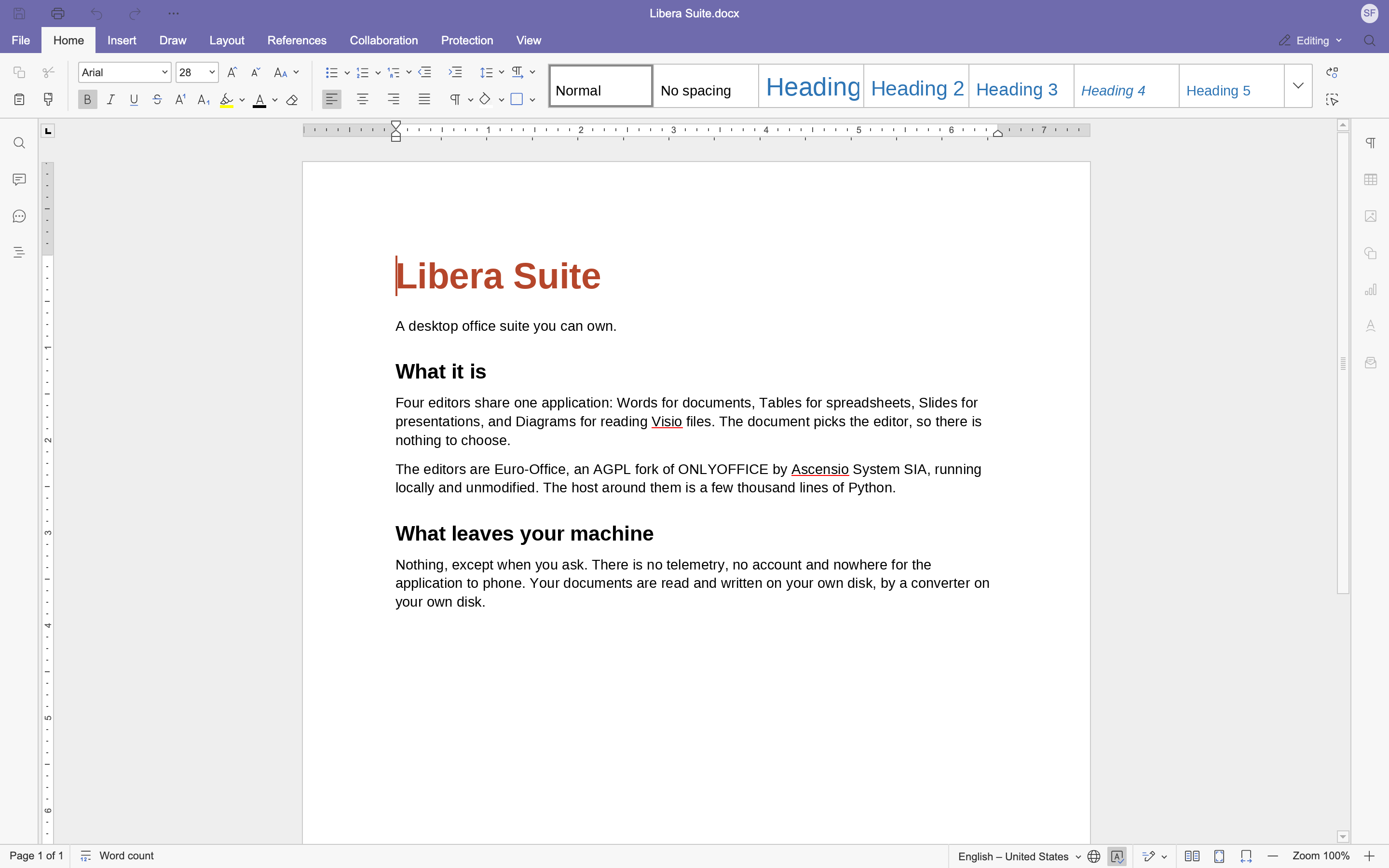
Abilian builds the host as free software under the Apache License 2.0. The editors inside it come from Euro-Office (itself an AGPL fork of ONLYOFFICE by Ascensio System SIA), running locally, with the document engine unmodified: our patch queue against them makes them build on every platform, brands them, sets a few of the editor's options, and fixes the converter.
libera report.docx        # a window, in Words, because the file says so
libera budget.xlsx        # Tables
libera *.pptx             # one window each
libera                    # the start window: new, open, recent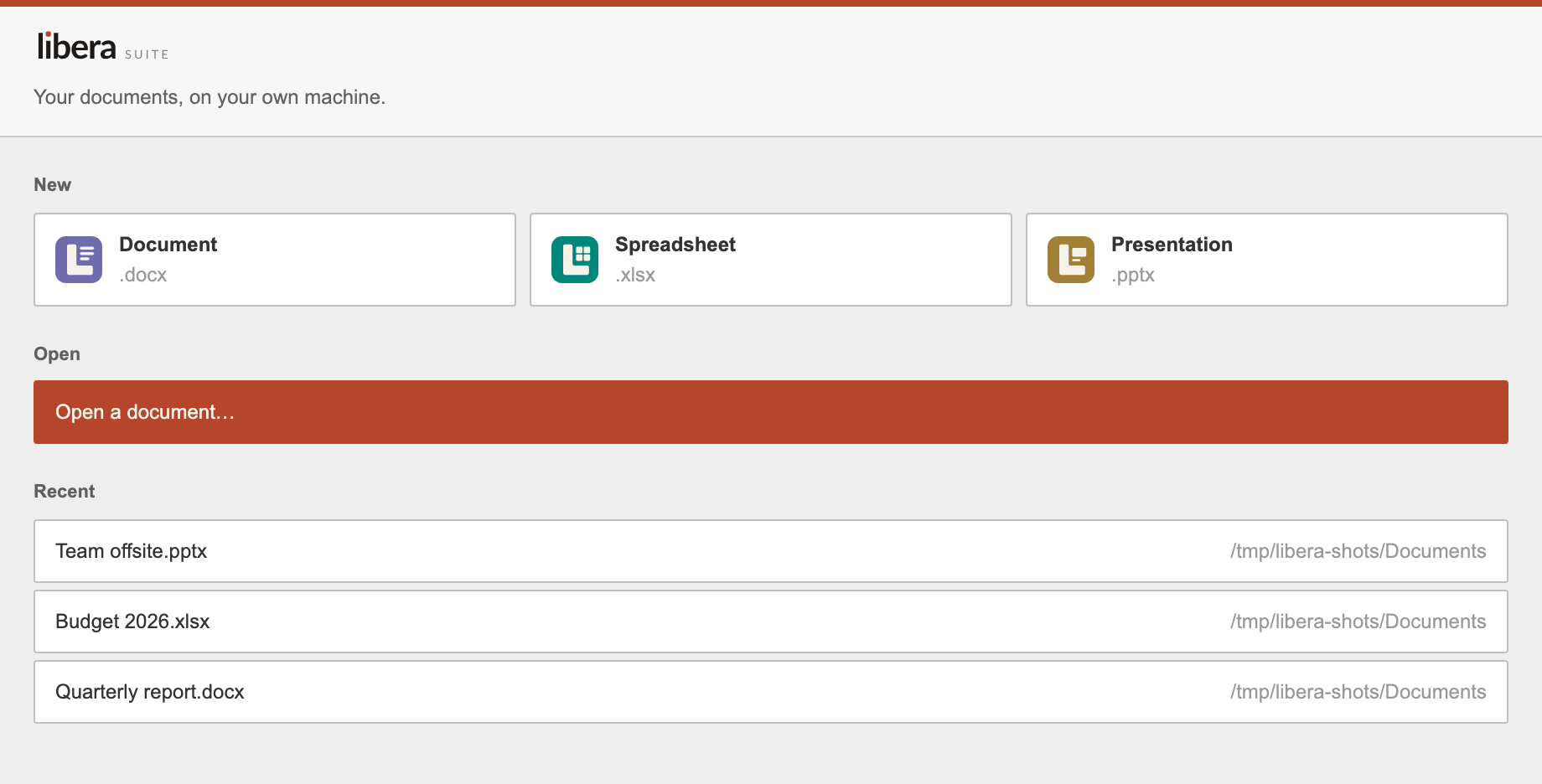
What works today sets out the full list with its gaps. It covers editing, saving and exporting, with PDF in the Save As popup. It also covers blank documents of all four kinds, images, printing, spell check in six languages, crash recovery and a Recent list.
libera -v FILE            # what it is doing; -vv how; -vvv every request
libera --diagnose         # everything worth pasting into a bug report
libera --payload-status # which editors are in use, and the revisions they were built fromThe editors are a web application. Everything they cannot do in a browser (read a file from disk, convert it, save it, list the fonts, put a dialog on screen) they ask of one injected JavaScript object, window.AscDesktopEditor, which the host exists to answer.
We implement it in Python, behind the webview your system already ships. The host serves the editor over a loopback HTTP server and defines AscDesktopEditor before the editor's own code runs, so nothing about the editor itself changes.
| The payload | The editors: sdkjs, web-apps, the x2t converter, fonts, dictionaries. Built from upstream sources pinned by SHA, plus our patch queue. ~120 MB, installed out of tree or shipped inside the bundle. |
| The host | src/libera/: the loopback HTTP server, the webview, the file dialogs, the menu bar and the converter calls, in about 4,700 lines of Python across 32 modules. All of the desktop application is here. |
| The bridge | Three small JavaScript files, spliced into the <head> of every page the host serves. Our code and theirs never share a file. |
Five thousand lines is a codebase a small team can read in an afternoon and still be maintaining in ten years.
We do not fork the engine. The patch queue makes upstream build on macOS and Windows, brands it, sets a few of the editor's options (no upstream helpdesk, no macros), and fixes the converter, mostly for OpenDocument files. None of it touches the editing engine, so following upstream means rebasing build configuration, settings and converter fixes. Every release records the exact revisions it was built from, so the corresponding source is a commit plus a series that provably reapplies to it, and lb payload patches checks that it still does.
Everything we ship, we build. build/ compiles the editors and the native converter from pinned upstream sources, on all three systems, with our patch queue applied.
Early, and running. All four editors work today on Windows 10 and 11 (x64), Linux (x86_64 and arm64) and macOS (Apple Silicon).
Tabs, and signing and notarisation on macOS, are still to come. Linux has a menu bar and a launcher entry; neither has keyboard shortcuts, because pywebview's GTK menu has no way to attach them. What works today lists the known issues, so an evening spent reporting one is an evening wasted. The roadmap says what comes next and what we have decided against.
The most useful thing you can send us is a document that renders wrongly, attached. The layout engine is upstream's and mature, so where output is wrong it is far more likely to be our packaging (a font we did not ship, a resource we failed to serve) than the engine.
Install gives the full instructions for each platform. There are four ways in. The first works on Linux and macOS alike.
One command, no root. It picks the channel that suits the machine:
curl -fsSL https://cdn.abilian.com/libera/install.sh | shHomebrew, on Linux and macOS alike:
brew install abilian/tap/libera
libera --payload-install
Linux: the Flatpak. The bundle includes the editors, GTK and WebKit, so there is nothing else to fetch and nothing to get wrong:
arch=amd64     # or arm64
ver=$(curl -fsSL https://cdn.abilian.com/libera/bundles/latest)
curl -fLO "https://cdn.abilian.com/libera/bundles/libera-$ver-$arch.flatpak"
flatpak install --user "./libera-$ver-$arch.flatpak"
flatpak run eu.liberasuite.Libera
From PyPI, where the libera command fetches the editors on first run:
pipx install --system-site-packages libera        # Linux: the flag is not optional
uv tool install libera                            # macOS
libera --payload-install
Linux works on both architectures. Payload 0.2 is built on Ubuntu 22.04, so the converter needs glibc 2.34 and GLIBCXX 3.4.26: Ubuntu 22.04, Debian 12 and anything newer, measured in a clean container of each. The Flatpak needs none of that, since the editors inside it run against the GNOME runtime.
macOS is Apple Silicon, on macOS 14 or later. There is no Intel build.
git clone https://github.com/abilian/libera-suite && cd libera-suite
uv sync
make payload                     # fetch, patch, build, assemble, smoke-test (long: V8 alone is ~30 min)
export LIBERA_PAYLOAD="$BUILD_ROOT/out/payload"
uv run libera document.docx
make verify # everything below, in the order that fails fastest
make test # unit, the host over HTTP, the editor in headless Chromium
make lint # ruff, ty, pyrefly, mypy, biome — green, and expected to stay that way
lb payload smoke # the converter: fonts, docx -> odt -> docx, docx -> pdf
lb payload patches # does the patch queue still apply to the pinned SHAs?The test suite enforces one house rule: assert on content, never on exit codes. A converter that writes an empty document exits zero. A PDF with no glyphs in it is the right size. So the end-to-end run photographs the editor's own canvas and measures the ink on it.
docs/ |
The documentation site, published at https://docs.liberasuite.eu/. Start at Developers. |
notes/ |
Where the reasoning lives: vision, specs, architecture, packaging, our relationship with upstream, the bugs that escaped to a user, a survey of how Euro-Office is put together. It stays in the development repository. |
build/ |
Building the editors and the native binaries from pinned source plus our patches. |
The package and the command are libera. The repository directory is local-office.
Libera Suite includes components from Euro-Office, itself a fork of ONLYOFFICE by Ascensio System SIA. Those components are AGPL v3 and are modified. The same line appears in Help ▸ About inside the application, in the editor's own About panel, and in what a software centre shows for the Flatpak.
The editors, the document engine and the format support are theirs. That is the hard part: twenty years of correctly reading a .docx written by somebody else's software. The host, the packaging and the desktop integration are ours. We are grateful for both.
Libera Suite ships as two artifacts under different licences.
The host is Apache-2.0: everything in src/libera/, which is the whole of this package.
The editor payload is AGPL-3.0: Euro-Office plus our patch queue against it (GUI assets are CC-BY-SA-4.0). It arrives as a separate download or inside a Flatpak, never vendored into the wheel.
Licence and attribution has the corresponding-source detail: what each release records, and where to fetch it.