Right now, this fork is primarily for making small changes to the code in a way that lets me share public links to commits. The plan currently is to have separate branches for each small functionality change.
There is a branch list below, but it won't always be up-to-date, especially on the non-master branches! The master branch will have the most up-to-date list!
I am also making more substantial changes to the original RBOT code as part of my MSc research (getting the code to run on a phone, working to improve the fps, working on some specific applications using this code, etc.), but am not quite ready to publicly share most of these changes yet. Said changes may eventually come to this repo or another one.
Current branches of interest:
webcam: a branch for tracking an object via the user's webcam and for handling initial poses by letting the user line up the object with an on-screen reference, similar to how some Vuforia apps work.datasetEval: a branch for evaluating the pose tracking on datasets. Currently, I haven't tested modeled occlusions in these evaluations, because of RAM limitations on my computer. Additionally, object resetting is done in the same way that SRT3D resets their tracking, where in addition to resetting the object to the ground truth pose after tracking loss, the histograms are reset. This does not seem to be the way that Tjaden et al. originally performed their evaluation, because the success scores can be quite different with this approach and they do not mention whether they reset histograms. If I only reset pose, then the success scores seem closer to what Tjaden et al. originally reported, but still not exactly the same. So, because I am not sure how Tjaden et al. evaluated their approach originally, I will be following SRT3D's approach for fairer comparisons with it.- It may be worth noting that, because the evaluation closely follows SRT3D's, the evaluation code structure somewhat mirrors how SRT3D's RBOT evaluator C++ code looks, though I've minimized things to the bare essentials.
cmakeChanges: a branch to showcase the changes I made to get the CMakeLists.txt provided by RBOT working on Windows 10.simpleAndroid: a branch to showcase the changes I made to get RBOT running on Android as a Qt project. The ideal would be to work on something that can be used outside of Qt, e.g., to use with the Unity game engine, but this branch probably won't cover that.ignoreThisBranch_BlenderVisWIP: Branch that was initially used to create a Blender visualization, and then when that "failed" for reasons described in that branch, was instead used to document why that was the case.
The README files have also been fixed to use the updated RBOT dataset download link, since the original leads to a 403 error right now.
Below is the original README (except for the fixed download link) from the original RBOT repo:
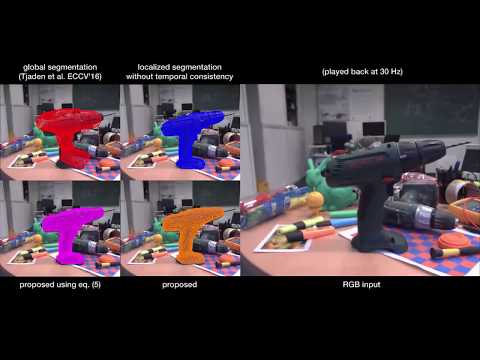
RBOT is a novel approach to real-time 6DOF pose pose estimation of rigid 3D objects using a monocular RGB camera. The key idea is to derive a region-based cost function using temporally consistent local color histograms and optimize it for pose with a Gauss-Newton scheme. The approach outperforms previous methods in cases of cluttered backgrounds, heterogenous objects, and occlusions. The proposed histograms are also used as statistical object descriptors within a template matching strategy for pose recovery after temporary tracking loss e.g. caused by massive occlusion or if the object leaves the camera's field of view. These descriptors can be trained online within a couple of seconds moving a handheld object in front of a camera.
-
A Region-based Gauss-Newton Approach to Real-Time Monocular Multiple Object Tracking H. Tjaden, U. Schwanecke, E. Schömer, D. Cremers, TPAMI '18
-
Real-Time Monocular Pose Estimation of 3D Objects using Temporally Consistent Local Color Histograms H. Tjaden, U. Schwanecke, E. Schömer, ICCV '17
-
Real-Time Monocular Segmentation and Pose Tracking of Multiple Objects H. Tjaden, U. Schwanecke, E. Schömer, ECCV '16
RBOT depends on (recent versions of) the following software libraries:
- Assimp
- OpenCV
- OpenGL
- Qt
The code was developed and tested under macOS. It should, however, also run on Windows and Linux systems with (probably) a few minor changes required. Nothing is plattform specific by design.
The general usage of the algorithm is demonstrated in a small example command line application provided in main.cpp. It must be run from the root directory (that contains the src folder) otherwise the relative paths to the model and the shaders will be wrong. Here the pose of a single 3D model is refined with respect to a given example image. The extension to actual pose tracking and using multiple objects should be straight foward based on this example. Simply replace the example image with the live feed from a camera or a video and add your own 3D models instead.
For the best performance when using your own 3D models, please ensure that each 3D model consists of a maximum of around 4000 - 7000 vertices and is equally sampled across the visible surface. This can be enforced by using a 3D mesh manipulation software such as MeshLab (http://www.meshlab.net/) or OpenFlipper (https://www.openflipper.org/).
To test the algorithm you can for example use the corresponding dataset available for download at: https://www.mi.hs-rm.de/~schwan/research/RBOT/
RBOT is licensed under the GNU General Public License Version 3 (GPLv3), see http://www.gnu.org/licenses/gpl.html.