




Greentic is the operating system for digital workers: deterministic, governed, multi-tenant automation that can safely use AI where it adds value and stay fully controlled where it matters most.
This is the kind of result Greentic is built for: a real digital worker that can receive requests, guide a user, create tickets, check status, escalate urgent issues, and operate consistently across channels.
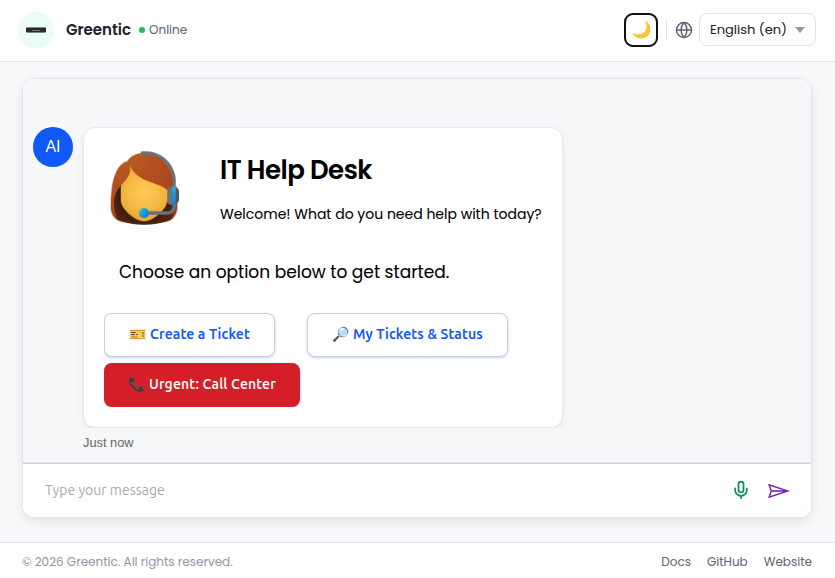
After installing Greentic, you only need three steps to get a working digital worker running.
gtc wizard --answers https://github.com/greenticai/greentic-demo/releases/latest/download/helpdesk-itsm-create-answers.jsongtc setup ./helpdesk-itsm-demo-bundle --answers https://github.com/greenticai/greentic-demo/releases/latest/download/helpdesk-itsm-setup-answers.json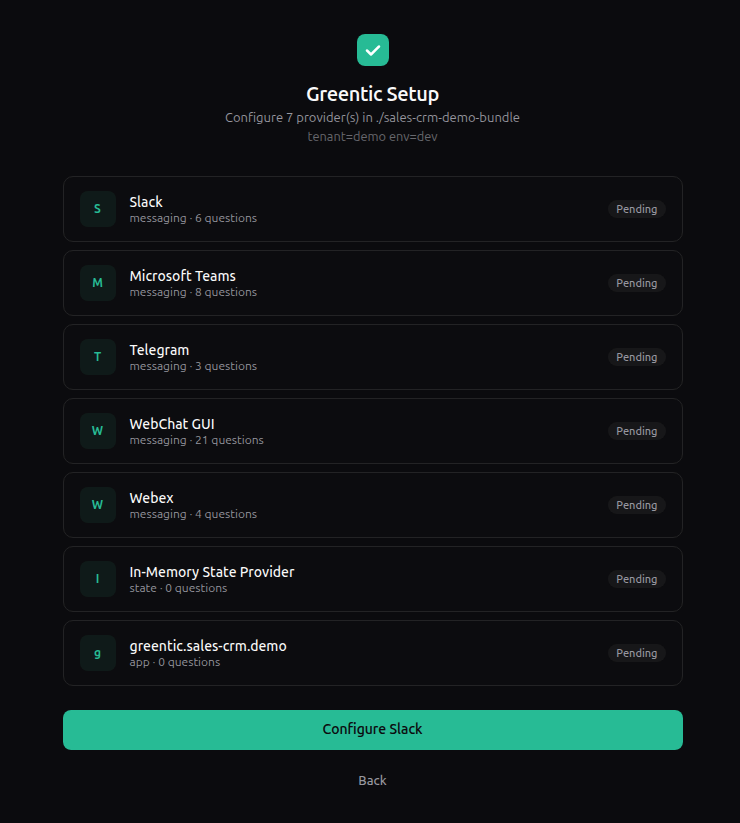
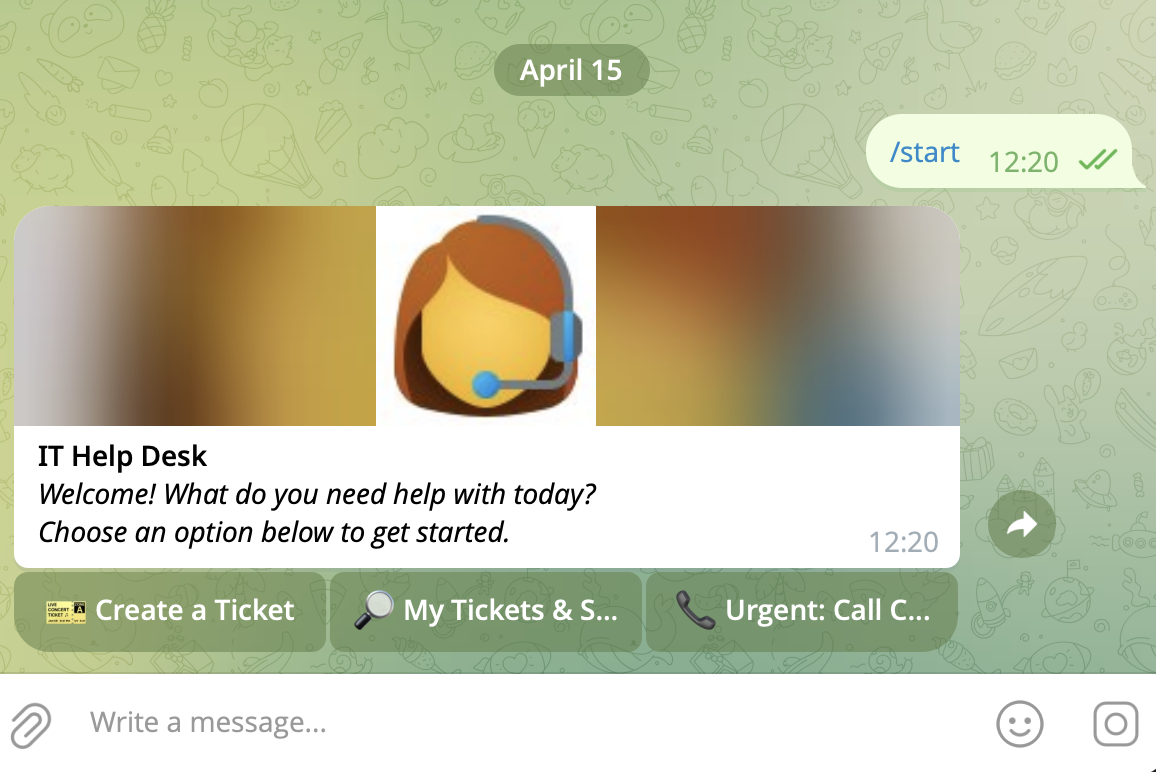
gtc start ./helpdesk-itsm-demo-bundleYour digital worker can then be used in:
- WebChat
- Microsoft Teams
- Slack
- Webex
- Telegram
- and more
The same pattern extends to cloud deployment.
gtc wizard --answers https://github.com/greenticai/greentic-demo/releases/latest/download/cloud-deploy-demo-create-answers.json
gtc setup --no-ui ./cloud-deploy-demo-bundle --answers https://github.com/greenticai/greentic-demo/releases/latest/download/cloud-deploy-demo-setup-answers.json
gtc start ./cloud-deploy-demo-bundle
Notes:
- For AWS,
gtc startnow auto-publishes a locally built.gtbundleto S3 and passes a presignedhttps://bundle URL into deploy. - If
GREENTIC_TERRAFORM_BACKEND_BUCKETis already set,gtcreuses it as the default S3 publish location and lets you keep or change it interactively. - The AWS path now requires the
awsCLI inPATH.
Greentic is designed so the path from local proof-of-value to production deployment is short, explicit, and repeatable.
Find more demos at greentic-demo
Greentic is evolving from powerful deterministic tooling into an even faster creation experience.
The goal is simple:
describe the business outcome you want, and generate the starting digital worker in seconds.
Embedded demo asset included in this package:
Before changing CLI behavior, docs, components, flows, packs, bundles, or examples, read:
Do not rely on demos, older examples, or other repos until you have checked the canonical docs and schema references in this repo.
AI demos are easy.
Production-grade AI execution is not.
Most agentic platforms make it easy to connect an LLM to tools, but much harder to guarantee what happens next. That is acceptable in experiments. It is not acceptable when workflows affect customers, employees, regulated processes, financial operations, or production systems.
A tiny hallucination rate may sound impressive in a lab. At enterprise scale, it becomes operational risk.
Greentic was built around a different idea:
Deterministic by default. Just enough AI to add real business value.
That means:
- flows are explicit
- capabilities are declared upfront
- execution is bounded
- policy can be enforced
- audit can be attached
- AI is used deliberately, not casually
Greentic is not trying to create mysterious black-box automation. It is trying to make digital work executable, governable, explainable, and deployable.
A digital worker is a deterministic system that completes a meaningful task end to end.
It is more than a chatbot and more than a workflow script.
A digital worker can:
- receive a message, event, webhook, form, or trigger
- understand which deterministic flow should run
- execute approved components and tools
- ask humans for input when needed
- apply policies and controls
- escalate exceptions
- produce a real business outcome
In practice, a digital worker often combines:
- message or event intake
- deterministic orchestration logic
- component or tool execution
- optional AI steps for routing, interpretation, or transformation
- human checkpoints where appropriate
The more repetitive, structured, and operationally important the task, the stronger the case for a digital worker.
If a process matters, you should be able to describe how it runs, what it is allowed to do, and how it is governed. If you cannot describe that, handing it to an unbounded agent does not remove the risk. It hides it.
Greentic exists to keep the benefits of AI while preserving the discipline of engineering.
Digital Workers need to interact with humans. That is why Greentic speaks over 50 languages: Hi, Hello, Hola, Bonjour, Hallo, Ciao, Olá, Привет, Здравейте, Γειά, Merhaba, مرحبا, שלום, नमस्ते, হ্যালো, ਸਤ ਸ੍ਰੀ ਅਕਾਲ, નમસ્તે, வணக்கம், నమస్తే, ನಮಸ್ಕಾರ, നമസ്കാരം, ආයුබෝවන්, வணக்கம், สวัสดี, Xin chào, Halo, Hai, Kumusta, 你好, 你好嗎, こんにちは, こんにちは, 안녕하세요, Сәлем, Салом, Салом, Сәләм, Сайн байна уу, မင်္ဂလာပါ, ជំរាបសួរ, ສະບາຍດີ, გამარჯობა, Բարև, Salut, Ahoj, Čau, Cześć, Szia, Bună, Zdravo, Bok, Pozdrav, Hej, Hei, Halló, Dia dhuit, Ola, Sawubona, Jambo.
Greentic is built from self-describing executable units.
- WebAssembly components for lightweight, portable execution
- WASIp2 sandboxing for isolation and control
- explicit capabilities per component
- explicit lifecycle: setup, update, remove
- self-describing contracts and runtime behavior
This makes systems easier to reason about, validate, reuse, and secure.
Flows define what happens.
- graph-based execution
- explicit transitions
- session-aware and stateless patterns
- shared state support
- canonical runtime formats for speed and consistency
You do not hope the right thing happens. You define it.
Digital workers need to interact with people and systems where work already happens.
Greentic supports messaging and event-driven patterns across channels such as:
- Slack
- Microsoft Teams
- Webex
- Telegram
- WebChat
- Webhooks
- SMS
- Timers
Greentic also supports adaptive-card style experiences and graceful channel-specific downscaling when one channel supports richer UI than another.
Digital workers need to work for humans, not force humans to work around systems.
Greentic is designed for multilingual operation and localized interaction, allowing digital workers to meet users in their own language across channels and UI surfaces.
Greentic uses AI where it is useful, but never as an excuse to remove control.
Examples include:
- Chat2Flow for routing intent to the right flow
- Chat2Data for turning natural language into system-specific dialects with guardrails
- Fast2Flow for fast routing with deterministic and fallback strategies
- explicit LLM components with declared permissions
AI is not ambient. It is capability-bound and intentionally placed.
Greentic can run MCP-style integrations without forcing everything through heavy remote patterns.
- lightweight local execution
- component-first design
- reduced transport overhead
- faster runtime behavior
- easier packaging and governance
Greentic is designed to be extended without turning the core into a mess.
Extension packs can provide:
- secrets backends
- shared state providers
- telemetry integrations
- OAuth providers
- policy layers
- routing engines
- deployers
- compliance hooks
- analytics hooks
- and more
Greentic-DW extends the platform toward higher-level agentic solution design while staying grounded in deterministic execution.
The point is not to make systems more chaotic. The point is to make sophisticated multi-step and multi-agent outcomes easier to design, review, and deploy safely.
Greentic-X is the path toward higher-level solution kits and domain packs that sit on top of the Greentic core.
Industry solutions are coming soon.
The long-term direction is to make it easier to compose industry-specific digital workers without abandoning the core principles of explicit execution, governance, and reusability.
System of Record Language is the direction for describing business structures, systems, and operational semantics at a higher level so they can be connected more naturally to digital workers.
The vision is straightforward:
- describe the business reality once
- map it to deterministic execution
- let digital workers operate against that model safely and consistently
These are some of the most important ideas in Greentic.
Capabilities define what a component or part of the system is allowed to do.
This avoids ambient authority and makes execution explicit. Instead of a component quietly having broad access to everything, capabilities make permissions visible and enforceable.
That matters for security, but also for architecture. Systems become easier to reason about when each unit can only do what it was explicitly granted to do.
Control layers allow policy and routing logic to shape execution.
They can be used to:
- deny unsafe or non-compliant actions
- route requests based on policy or context
- enforce region, tenant, or team-specific behavior
- inject governance before work proceeds
- implement decisioning that is explicit and auditable
This is how you move from “the workflow ran” to “the workflow ran under policy.”
Observer layers allow you to attach audit, analytics, monitoring, and compliance visibility around execution.
They can be used to:
- produce audit trails
- monitor execution behavior
- export telemetry
- track policy decisions
- support governance and compliance reviews
- measure operational effectiveness
This is how digital workers become acceptable in serious enterprise environments. They do not just execute. They execute with oversight.
Greentic favors structured, reproducible creation over hidden configuration.
The gtc wizard flow is central to that experience.
gtc wizard --schemaThis lets you inspect the questions and structure used to create artifacts.
gtc wizard --answers <answers.json>This lets you generate repeatable outputs from an explicit answer set.
That matters because:
- environments become reproducible
- setup becomes reviewable
- automation becomes easier
- CI/CD becomes cleaner
- generated bundles can be recreated deterministically
The same philosophy carries into setup:
gtc setup ./some-bundle --answers <setup-answers.json>Greentic is opinionated about making the path from intent to runnable system explicit.
Install Greentic via cargo-binstall.
cargo binstall gtc
gtc install
If you prefer installing from source:
git clone https://github.com/greenticai/greentic.git
cd greentic/greentic
cargo install --path . --locked
gtc install# Latest stable toolchain, companion binaries, stable packs, and stable components
gtc install
# Specific release and channel
gtc install --release 1.0.16 --channel stableSupported install channels are stable, dev, and rnd (rnd means research
and development). For production-ready pack and component references, use the
stable OCI tag, for example oci://ghcr.io/...:stable, rather than
oci://ghcr.io/...:latest.
gtc wizard and gtc setup warn when the installed release context is not the
latest release for the launcher's channel (gtc -> stable, gtc-dev ->
dev, gtc-rnd -> rnd). Use --strict-release-context to fail on a mismatch,
or --ignore-release-context to skip the check.
Rust 1.95 is required. gtc install checks the install toolchain before it
installs companion Greentic tools.
Required local tools and targets:
cargo-componentwasm32-wasip2cargo-binstall
If cargo-component or wasm32-wasip2 are missing, gtc install tries to
install them for the current platform before continuing. If automatic
installation is not available in your environment, install them manually and run
gtc install again.
curl --proto '=https' --tlsv1.2 -sSf https://sh.rustup.rs | sh
rustup toolchain install 1.95.0
rustup target add wasm32-wasip2
cargo install cargo-component
cargo install cargo-binstall
Confirm installation:
cargo --version- Install Rust first from the official Rust installer page.
- Run
rustup-init.exe. - Open a fresh terminal afterwards so
cargois onPATH. - When Windows shows a security popup during
cargo binstall gtc, confirm it. - If that popup is dismissed, rerun the command and allow it before running
gtc install.
Greentic builds digital workers in layers:
Component → Flow → Pack → Bundle → Operator
- WASM module
- self-describing contract
- explicit capabilities
- deterministic lifecycle
- graph of nodes
- YAML authoring to production artifact path
- explicit transitions
- distribution unit
- components plus flows
- versioned and validated
- doctor and validation workflows
- defines deployed packs
- configures tenant and team access
- enables extensions and providers
- setup phase
- start phase
- capability enforcement
- controlled runtime boundary
- warmup and execution lifecycle
Best for interactive and session-based workflows.
- multi-step conversations
- adaptive card support
- channel translation and downscaling
- stateful user journeys
Best for stateless and trigger-driven workflows.
- webhooks
- timers
- SMS
- fire-and-forget processing
Greentic supports both because real business work spans both.
Greentic avoids the common failure modes of uncontrolled agent systems.
It avoids:
- unbounded autonomous execution
- hidden permissions
- undefined tool-calling behavior
- ambient authority
- unclear operational accountability
Instead, Greentic favors:
- explicit flows
- bounded execution
- declared capabilities
- versioned configuration
- reproducible setup and deployment
That is what makes it enterprise-ready by design.
Greentic is designed for real organizational structure.
Hierarchy:
- Global
- Tenant
- Team
- User
The operator denies by default. Access must be explicitly granted.
This matters for isolation, governance, and safe shared infrastructure.
Greentic is engineered for lightweight execution.
- small runtime artifacts
- fast startup and warmup characteristics
- reduced transport overhead
- local component execution patterns
- deterministic payload passing
The aim is not to be flashy. It is to be fast enough, small enough, and controlled enough to be practical everywhere.
This comparison is intended as a high-level product positioning view, not a protocol shootout.
Legend: ✅ = strong / first-class, ⚠️ = present but partial or stack-dependent, ❌ = not a core strength, 🚧 = emerging in Greentic.
| Capability | Greentic | Microsoft Foundry agent stack | OpenAI agent stack | Google Vertex AI agent stack | LangGraph / LangChain | CrewAI | AutoGen |
|---|---|---|---|---|---|---|---|
| Deterministic execution first | ✅ | ||||||
| Agentic / multi-agent support | ✅ | ✅ | ✅ | ✅ | ✅ | ✅ | ✅ |
| Human-in-the-loop workflow patterns | ✅ | ✅ | ✅ | ✅ | ✅ | ✅ | |
| Enterprise identity / network controls | ✅ | ✅ | ✅ | ❌ | ❌ | ||
| Managed runtime / hosted production surface | ✅ | ✅ | ✅ | ❌ | ❌ | ||
| Built-in tracing / observability | ✅ | ✅ | ✅ | ✅ | ✅ | ||
| Prompt designer | 🚧 | ✅ | ✅ | ❌ | ❌ | ||
| Store | 🚧 | ✅ | ❌ | ✅ | ❌ | ❌ | ❌ |
| Multi-tenant orientation | ✅ | ❌ | ❌ | ||||
| Lightweight runtime artifacts | ✅ | ❌ | ❌ | ❌ | ❌ | ❌ | ❌ |
Greentic is not trying to out-demo everyone. It is trying to give enterprises a cleaner foundation for controlled digital work.
greentic-interfaces— shared WASM interfacesgreentic-types— shared structures and schemasgreentic-component— component tooling and lifecyclegreentic-flow— flow tooling and orchestration assetsgreentic-pack— pack creation and validationgreentic-operator— bundle execution runtimegreentic-dev— developer-facing toolsgreentic-mcp— MCP-related tooling and runtime patternsgreentic-messaging-providers— Teams, Slack, Webex, and moregreentic-events-providers— webhook, timer, SMS, email, and more- extension repos for OAuth, state, session, telemetry, and related concerns
component-*— open source reusable components
- Greentic AI Ltd — the company behind Greentic
- 3Point.ai with 3AIgent powered by Greentic — get AI ROI quickly
- DataArt — core contributors and certified technical consultants
- Become a sponsor
Greentic is built for people who care about serious production systems, reusable platform design, and controlled AI execution.
- Fork the repository
- Create a feature branch
- Add or update tests
- Run formatting and linting
- Open a pull request
- design explanation
- migration notes when applicable
- test coverage for behavior changes
Contributions that improve clarity, determinism, security, tooling, and reuse are especially valuable.
Greentic emphasizes explicit evolution over silent drift.
- semantic versioning
- stable component contracts
- controlled migration paths
- explicit deprecations
The goal is to make upgrades manageable and system behavior understandable over time.
Security is not an afterthought in Greentic. It is a design principle.
Greentic enforces:
- capability-based execution
- WASIp2 sandboxing
- no ambient authority
- tenant-aware isolation
- explicit runtime boundaries
Traditional automation often focuses only on whether something can run.
Greentic also focuses on:
- whether it should run
- under which policy it can run
- what should be observed when it runs
- what evidence should exist afterwards
That makes control and observer valuable not only for platform design, but for compliance, governance, and trust.
Control can stop or shape unsafe execution. Observer can create the auditability required for regulated or sensitive workflows.
Together, they help move digital workers from experimentation into enterprise-grade operations.
Report vulnerabilities responsibly according to the project security process.
Greentic is maintained by the Greentic core team and contributors.
Community governance will continue to mature as the ecosystem grows.
See LICENSE for details.
Greentic is not a toy workflow builder.
It is not a prompt wrapper.
It is not an uncontrolled agent runtime.
If you want AI without giving up control, if you want automation without losing auditability, and if you want digital workers that can actually be deployed across serious organizations, Greentic is the foundation.
Build digital workers. Run them under policy. Scale them with confidence.
Visit Greentic.ai
