
Plan the workday around the heat, not against the paycheck.
₹800 is a heat-aware work planner for outdoor workers in India who can't afford to take the day off in a heatwave. An electrician types (or dictates, in Hindi or English) the jobs they actually have today, with pay, time window and sun or shade. A constraint solver (Google OR-Tools CP-SAT on AWS Lambda) rearranges the day around the hourly heat index. Rooftop work moves to 06:30, cooled indoor work goes in a hot late-morning slot and travel and rest are scheduled as real blocks. If the income target can't be reached without breaking a heat rule, it says so and shows the exact shortfall and the reason for every dropped job. It never relaxes a rule to make the money work.
| Demo video | https://www.youtube.com/watch?v=xtvfS-8Q3ro (2:04) |
| Live app | https://main.d231iqub8spohk.amplifyapp.com |
| API health | https://4l3js7p5ub.execute-api.us-east-1.amazonaws.com/api/v1/health |
| Event | WeMakeDevs × AWS Environmental Hacks 2026, Heat & Water track |
Backend (Python 3.12):
cd services/api
python3.12 -m venv .venv
./.venv/bin/pip install -r requirements.txt -r requirements-dev.txt
./.venv/bin/python -m pytest -q
./.venv/bin/uvicorn app.main:app --port 8000
Frontend (Node 22), in a second terminal:
cd apps/web
npm install
npm run dev
Open http://localhost:3000, click Explore the heatwave example, then Generate work plan, then Replan with +3°C.
The committed apps/web/.env.development points the dev server at http://127.0.0.1:8000, so no setup is needed. Plans are kept in memory unless PLANS_TABLE is set, so the demo path needs no AWS account. Two things need the network: the first npm run dev or build downloads the Google Fonts, and reading jobs from text needs MODAL_API_KEY, or AWS credentials with Bedrock access when that variable is unset.
1. The day, rearranged. The top row is the day as booked, the bottom row is the solver's plan. Each column is one hour, shaded by heat-index band. The rooftop job (☀1) was booked for 09:00, already in the danger band, so it moves to 06:30. Travel (hatched) and rest (blue) are explicit blocks.

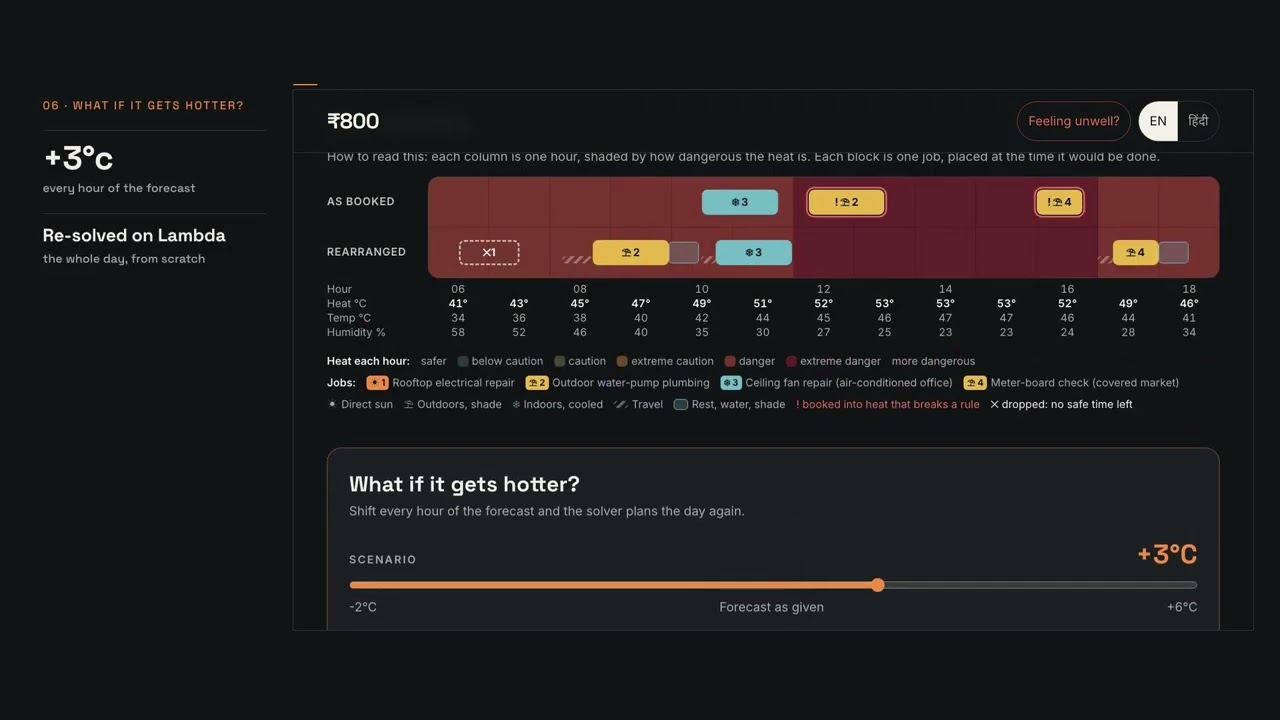
2. Make it hotter. Slide the forecast up and the backend re-solves from scratch. At +3 °C every rooftop slot breaks the direct-sun rule, so that job is gone (✕1). The plan falls to ₹650 and explains each change.

3. In Hindi, on a phone-sized screen. The whole UI switches to Hindi. The Feeling unwell? button is on every screen and shows guidance to stop work and get help (108, 112).

These numbers come from the solver. Tests pin the income at each step, the 06:30 rooftop start and the 26.5% exposure reduction (shown rounded as 27%).
| Forecast | Income | What happens |
|---|---|---|
| +0 °C | ₹800 of ₹800 | Rooftop job moves 09:00 → 06:30. Exposure score 27% lower than the day as booked. |
| +3 °C | ₹650 (₹150 short) | Rooftop job (₹300) removed: every slot breaks the direct-sun rule. The ₹150 meter job is added back to recover part of it. |
| +5 °C | ₹250 | The air-conditioned job also drops (getting there means travelling in extreme danger) and the meter job drops (no safe slot leaves time to rest before the workday ends). |
-
Every 15-minute slot gets an NWS heat-index band from the forecast (demo: a labelled synthetic Lucknow heatwave; live: Open-Meteo).
-
Hard rules remove slots:
- Extreme danger: no work outside a cooled room and no travel between jobs.
- Danger: no heavy work, and no direct-sun work for anyone not used to heat (the default when unsure).
- Rest: the rest block after an outdoor job must end inside the working hours.
-
CP-SAT solves in three lexicographic phases:
- find the most the worker can earn from their own jobs inside the rules
- then minimize the modelled exposure score with income at or above the target (or at that maximum, if the target is out of reach). Income above the target is not chased, so a job can be left out when the target is met with less heat without it
- then stay as close as possible to the booked times
Jobs never overlap, travel and rest are explicit intervals and fixed appointments never move.
-
A separate validator re-checks every solution before it is returned: windows, workday, heat rules, the required rest length and overlaps. If it disagrees with the solver, the API returns an error instead of a plan.
-
"As booked" is the same jobs at their booked times with no heat rules. The percentage compares those two scores.
The language model only turns speech into draft job cards, which the worker confirms field by field. It never decides timing or safety.
Full rules, weights and limits: /methodology in the app, or services/api/app/policy.py.
Browser (Next.js static export, EN / हिंदी)
   │  HTTPS
Amplify Hosting ──► API Gateway HTTP API (throttled 10 rps)
                        │
                    AWS Lambda: FastAPI + Mangum
                    ├─ weather.py     demo fixture or Open-Meteo, +ΔT scenario copy
                    ├─ heat_index.py  NWS Rothfusz heat index, screening bands
                    ├─ policy.py      hard rules, rest blocks, exposure weights
                    ├─ optimizer.py   CP-SAT: max income → min exposure → min drift
                    ├─ parse_jobs.py  Modal GLM 5.3 (OpenAI-compatible) or Bedrock → draft jobs
                    └─ store.py       DynamoDB plans, 7-day TTL
                        │
                    CloudWatch: plan_generated / plan_recalculated JSON events
| Service | Role |
|---|---|
| AWS Lambda | FastAPI and OR-Tools CP-SAT, zip deploy. Typical solve takes 50 to 250 ms. |
| API Gateway HTTP API | Public API with stage throttling and CORS. |
| DynamoDB | Every plan and replan, linked by parent_plan_id and stored with its diff. 7-day TTL. |
| CloudWatch | Structured plan_generated, plan_recalculated and jobs_parsed events. |
| Amplify Hosting | Static Next.js site. |
| Bedrock | Alternative provider for job reading, used only when MODAL_API_KEY is unset (there is no automatic failover). The deployed app uses GLM 5.3 on Modal. Bedrock inference has not been exercised in this deployment. |
| Endpoint | Purpose |
|---|---|
POST /api/v1/plans/optimize |
Solve a day from target, hours, jobs and weather mode |
POST /api/v1/plans/{id}/simulate |
Re-solve the same inputs with the forecast shifted by -2 to +6 °C, returns a diff |
GET /api/v1/plans/{id} |
Fetch a stored plan |
POST /api/v1/jobs/parse |
Hindi or English text to draft jobs via Modal (or Bedrock, by configuration) |
GET /api/v1/weather |
Annotated hourly weather (demo or live) |
GET /api/v1/methodology |
Policy version, rules, weights and limits |
GET /api/v1/health |
Health and storage backend |
./infrastructure/deploy.sh       # DynamoDB, IAM role, Lambda (zip via S3), API Gateway HTTP API; prints API_URL
echo "NEXT_PUBLIC_API_URL=<API_URL>" > apps/web/.env.production
./infrastructure/deploy-web.sh   # static Next.js export to Amplify Hosting; prints WEB_URL
Both scripts are idempotent and need only the AWS CLI and Python 3.12 (no Docker). OR-Tools Linux wheels unzip to about 158 MB, under Lambda's 250 MB limit. CODE_ONLY=1 ./infrastructure/deploy.sh updates the function code and keeps its environment.
| Variable | Where | Purpose |
|---|---|---|
NEXT_PUBLIC_API_URL |
apps/web/.env.production |
API Gateway base URL, no trailing slash |
PLANS_TABLE |
Lambda (set by deploy.sh) |
DynamoDB table for plans |
ALLOWED_ORIGINS |
Lambda (set by deploy.sh) |
Comma-separated CORS origins |
BEDROCK_MODEL_ID |
Lambda (set by deploy.sh) |
Model used when job reading runs on Bedrock, default Claude Haiku 4.5 |
MODAL_API_KEY |
your shell before deploy.sh |
If set, job reading uses a Modal-hosted model (OpenAI-compatible API) instead of Bedrock |
MODAL_BASE_URL, MODAL_MODEL |
your shell before deploy.sh |
Optional. Default to https://inference.us-west.modal.direct/v1 and the GLM 5.3 endpoint |
cd services/api && ./.venv/bin/python -m pytest -q39 tests cover:
- Solver basics: income sums, fixed-appointment overlap, availability windows, shortfall, determinism, empty input and input validation.
- Heat rules: heavy-work bans, travel never in extreme danger, rest ending inside the workday and the target never relaxing a rule.
- Robustness: scenario copies never mutate the source forecast, travel and rest never overlap, a timeout in any solver pass still returns a valid plan marked not proven optimal and the validator rejects a plan with too little rest.
- Replans: they are stored with their diff, shift the forecast the original plan was solved on (no refetch, so a weather outage can't break them) and still work after the plan's date has passed.
- Inputs: incomplete live forecasts return 503, pay over ₹1,00,000 returns 422 and drafted jobs never get a shorter duration or a looser time window when snapped to 15 minutes.
- Job reading: provider selection and three Modal reply shapes (tool call, JSON in content, JSON only in reasoning). The Bedrock path is not covered by tests.
- Demo numbers: ₹800 at +0 °C with the rooftop job at 06:30 and a 26.5% lower exposure score, ₹650 at +3 °C with only the rooftop job removed and ₹250 at +5 °C.
apps/web/            Next.js 16 app (landing, job entry, plan, simulator, methodology), EN and Hindi
services/api/app/    FastAPI service: solver, heat index, policy, job parsing, storage
services/api/tests/  pytest suite
infrastructure/      deploy.sh (Lambda, API Gateway, DynamoDB) and deploy-web.sh (Amplify)
docs/                submission write-up, demo script, screenshots
videos/rs800-demo/   demo video source: Playwright recorder, VHS tape, cut script, HyperFrames storyboard
This is a scheduling prototype, not a certified occupational safety assessment. The heat rules and exposure weights are prototype guardrails and ranking coefficients, not validated thresholds or a medical risk. The heat index is a shade-based screening value, not WBGT, and a forecast is not an onsite measurement. Demo weather and jobs are synthetic and labelled on every screen.
- Weather: Open-Meteo (CC BY 4.0). Heat index: US National Weather Service Rothfusz regression.
- Hero images are AI-generated (OpenAI image generation via Codex CLI).
- Demo video: real screen recordings of the live app and AWS CLI, edited with HyperFrames, narrated with HeyGen text to speech.
- AI coding tools used: Claude Code (Claude Opus 5.5) for code and docs, Codex CLI for images.