
NeurIPS 2026
Hyojun Go1 ·
Hyungjin Chung ·
Prune Truong2 ·
Goutam Bhat2 ·
Li Mi1 ·
Zhaochong An3
Zixiang Zhao1 ·
Dominik Narnhofer1
Serge Belongie3 ·
Federico Tombari2 ·
Konrad Schindler1
1ETH Zürich · 2Google · 3University of Copenhagen
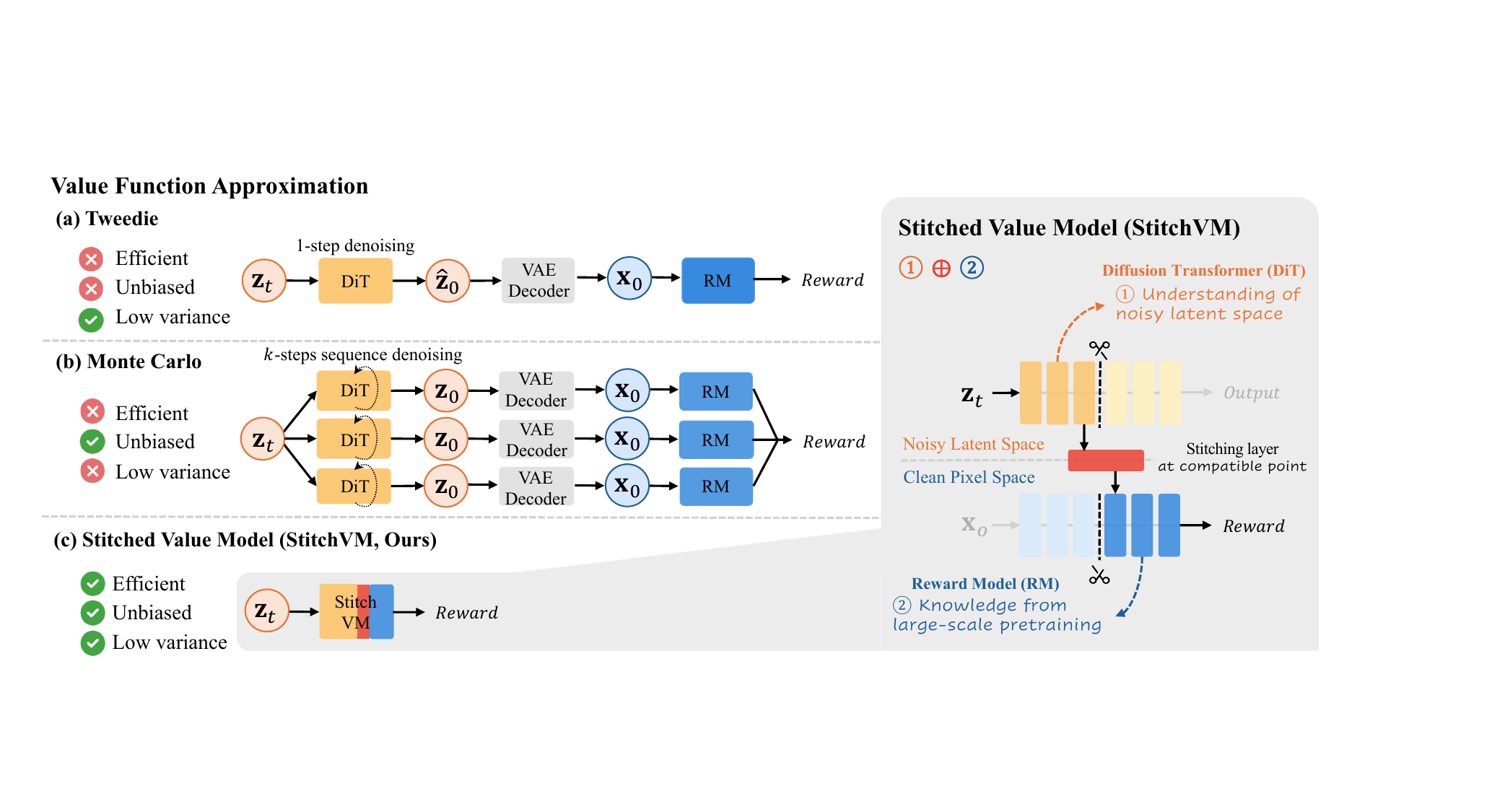
StitchVM turns pretrained pixel reward models (CLIP, HPSv2, Aesthetic Predictor, and DFN-CLIP) into value models that score noisy diffusion latents directly, at small compute cost. The resulting value models can be used in diffusion-alignment methods such as DPS, FK steering, DRaFT, and DiffusionNFT.
See the project page for the full story, figures, and results.
The code supports stitching-layer search and value-model distillation for all 12 combinations of SD3.5 Medium, SD3.5 Large, and FLUX.1-dev with HPSv2, CLIP, Aesthetic, and DFN-CLIP reward encoders.
Pretrained StitchVM EMA checkpoints are available on Hugging Face for all 12 supported backbone–reward combinations.
Layer pairs follow the training configurations and denote DiT → reward-encoder block outputs, indexed from 1.
| Diffusion backbone | Reward model | DiT → Encoder | EMA checkpoint |
|---|---|---|---|
| SD3.5 Medium | HPSv2 | 3 → 1 | Download |
| SD3.5 Medium | CLIP | 3 → 2 | Download |
| SD3.5 Medium | Aesthetic | 3 → 2 | Download |
| SD3.5 Medium | DFN-CLIP | 5 → 2 | Download |
| SD3.5 Large | HPSv2 | 13 → 1 | Download |
| SD3.5 Large | CLIP | 12 → 2 | Download |
| SD3.5 Large | Aesthetic | 12 → 2 | Download |
| SD3.5 Large | DFN-CLIP | 15 → 2 | Download |
| FLUX.1-dev | HPSv2 | 9 → 1 | Download |
| FLUX.1-dev | CLIP | 9 → 2 | Download |
| FLUX.1-dev | Aesthetic | 9 → 2 | Download |
| FLUX.1-dev | DFN-CLIP | 9 → 2 | Download |
- Release pretrained StitchVM checkpoints.
- Add support for additional diffusion backbones and reward models.
- Release inference-time alignment code.
Want to use StitchVM with a particular diffusion backbone and reward model? Submit a model integration request with your model combination, use case, and where you would like help.
The training recipe in this repository differs from the paper. We introduced multi-resolution training to improve support across image resolutions. The current recipes use 512×512, 768×768, 1024×1024, 768×1024, and 1024×768 VAE inputs; DFN-CLIP uses the three square resolutions. Reward encoders retain their native input sizes, and stitching-layer search uses the same resolution buckets as training.
The documentation describes the current repository configuration. It should not be treated as an exact reproduction of the paper's training setup or reported results.
Follow shared setup to install the environment, download the
pretrained diffusion/reward dependencies, and prepare HPDv2 + AVA. It also
explains the DATA, INIT, and OUT paths used by the commands below.
The stage numbers are repository workflow labels, distinct from the paper's terminology. Each guide combines setup, launch commands, detailed configuration, results, and an implementation file map.
Extract paired features from the frozen diffusion backbone and reward encoder, then fit an affine adapter for each candidate pair. Each search uses 300 images: 200 for fitting and 100 for validation, with the first half of DiT blocks and the first four reward-encoder blocks as candidates. VAE resolutions match the training buckets; reward inputs keep their native sizes.
# List the twelve recipes, then run CLIP with SD3.5 Medium.
bash scripts/stage1_find_stitching_layer.sh
bash scripts/stage1_find_stitching_layer.sh stage1_clip
See the full search guide for all twelve recipes, configuration details, output files, and how to choose a layer pair.
Initialize from the fitted adapter, then train the adapter and reward-encoder suffix for five epochs, keeping the VAE, diffusion backbone, and reward teacher frozen. The recipes use multi-resolution inputs, AdamW, and EMA decay 0.999.
Base learning rates are 5e-5 for SD3.5 Medium and FLUX, and 1e-5 for SD3.5 Large, with adapter multiplier 1. Global batch is 256 for SD3.5 HPSv2/CLIP/Aesthetic and 128 for FLUX and all DFN-CLIP pairs; accumulation preserves these targets when changing the per-device micro-batch.
# Preview the resolved settings, then train the matching pair.
DRY_RUN=1 bash scripts/stage2_train_stitched_model.sh stage2_clip
bash scripts/stage2_train_stitched_model.sh stage2_clip
See the full distillation guide for pair-specific layers, learning rates, batch sizes, losses, memory settings, and checkpoint outputs.
Selected DiT → reward-encoder block outputs (one-based):
| Backbone | HPSv2 | CLIP | Aesthetic | DFN-CLIP |
|---|---|---|---|---|
| SD3.5 Medium | 3 → 1 | 3 → 2 | 3 → 2 | 5 → 2 |
| SD3.5 Large | 13 → 1 | 12 → 2 | 12 → 2 | 15 → 2 |
| FLUX.1-dev | 9 → 1 | 9 → 2 | 9 → 2 | 9 → 2 |
The full search results include candidate counts, fit MSE, and validation MSE for all twelve pairs. Fresh stochastic searches can produce different values.
Reported intrinsic evaluation after five epochs, using epoch-5 EMA weights and 1024×1024 evaluation inputs. Each cell is the best primary score over the reported noise sweep σ ∈ {0, 0.1, 0.25, 0.5, 0.75, 0.9}.
| Backbone | HPSv2 preference accuracy | CLIP Image R@1 | Aesthetic SRCC | DFN-CLIP Image R@1 |
|---|---|---|---|---|
| SD3.5 Medium | 81.70% | 39.14% | 0.6306 | 54.21% |
| SD3.5 Large | 82.01% | 39.16% | 0.6315 | 54.29% |
| FLUX.1-dev | 82.15% | 39.29% | 0.6335 | 54.37% |
Benchmarks: HPDv2 test for HPSv2, MSCOCO 5k for retrieval, and AVA 20k for Aesthetic. The full benchmark results include peak noise levels, unstitched baselines, and all supplied metric breakdowns. The retrieval breakdown covers selected noise levels. Checkpoints are not yet released. Standalone intrinsic-evaluation and diffusion-alignment launchers are not included in this code release.
@inproceedings{go2026stitchvm,
  title     = {Stitched Value Model for Diffusion Alignment},
  author    = {Go, Hyojun and Chung, Hyungjin and Truong, Prune and Bhat, Goutam and
               Mi, Li and An, Zhaochong and Zhao, Zixiang and Narnhofer, Dominik and
               Belongie, Serge and Tombari, Federico and Schindler, Konrad},
  booktitle = {Advances in Neural Information Processing Systems (NeurIPS)},
  year      = {2026}
}For questions about the method or paper, please open a GitHub issue or contact Hyojun Go.