



ScienceFlow turns an executable task with a measurable objective into persistent, evaluator-guided research. It coordinates parallel workers, promotes valid results into recoverable stages, preserves the best artifacts, and exposes the full process through a TUI and Web monitor.
- [2026-09] Released the ScienceFlow harness preview for long-horizon scientific research agents, with TUI and Web interfaces.
- [2026-08] Released ScienceFlow commit ad1f7dd and arXiv.
Requirements: Python 3.11–3.13 and access to a supported model API.
Create an isolated Conda environment, then install ScienceFlow from PyPI:
conda create -n scienceflow python=3.12 -y
conda activate scienceflow
python -m pip install scienceflow==0.2.0
scienceflow --help
Other installation methods
pipx
pipx install scienceflow==0.2.0uv
uv tool install scienceflow==0.2.0Python virtual environment
python3 -m venv .venv
source .venv/bin/activate
python -m pip install scienceflow==0.2.0scienceflow config init
scienceflow config path # edit the generated private model registry
scienceflow tui
Chat normally in the TUI, or enter /long-research to configure and launch a
managed task. Closing the TUI detaches from research without terminating its workers.
The built-in circle-packing example needs no dataset. After starting the TUI,
complete these prompts in order:
1 · Prepare the task
/long-research circle-packing workers=2 cpu=16 gpu=cpu duration=1h
2 · Start after preflight passes
run
ScienceFlow runs preflight checks, starts two CPU workers, evaluates candidate solutions,
and retains the best valid artifact under the workspace. Follow it with
/tasks or /status 1.
| Command | Purpose |
|---|---|
/long-research DESCRIPTION | Prepare and launch a research task. |
/tasks, /status N | List tasks or inspect results, model usage, and resources. |
/stop N, /resume N, /attach N | Control or follow a task. |
/models | Select the fixed chat model. |
/web, /web stop | Start or stop the workspace Web monitor. |
Choose a saved chat session with:
scienceflow tui --resumeSee the runtime guide for workspace and execution details.
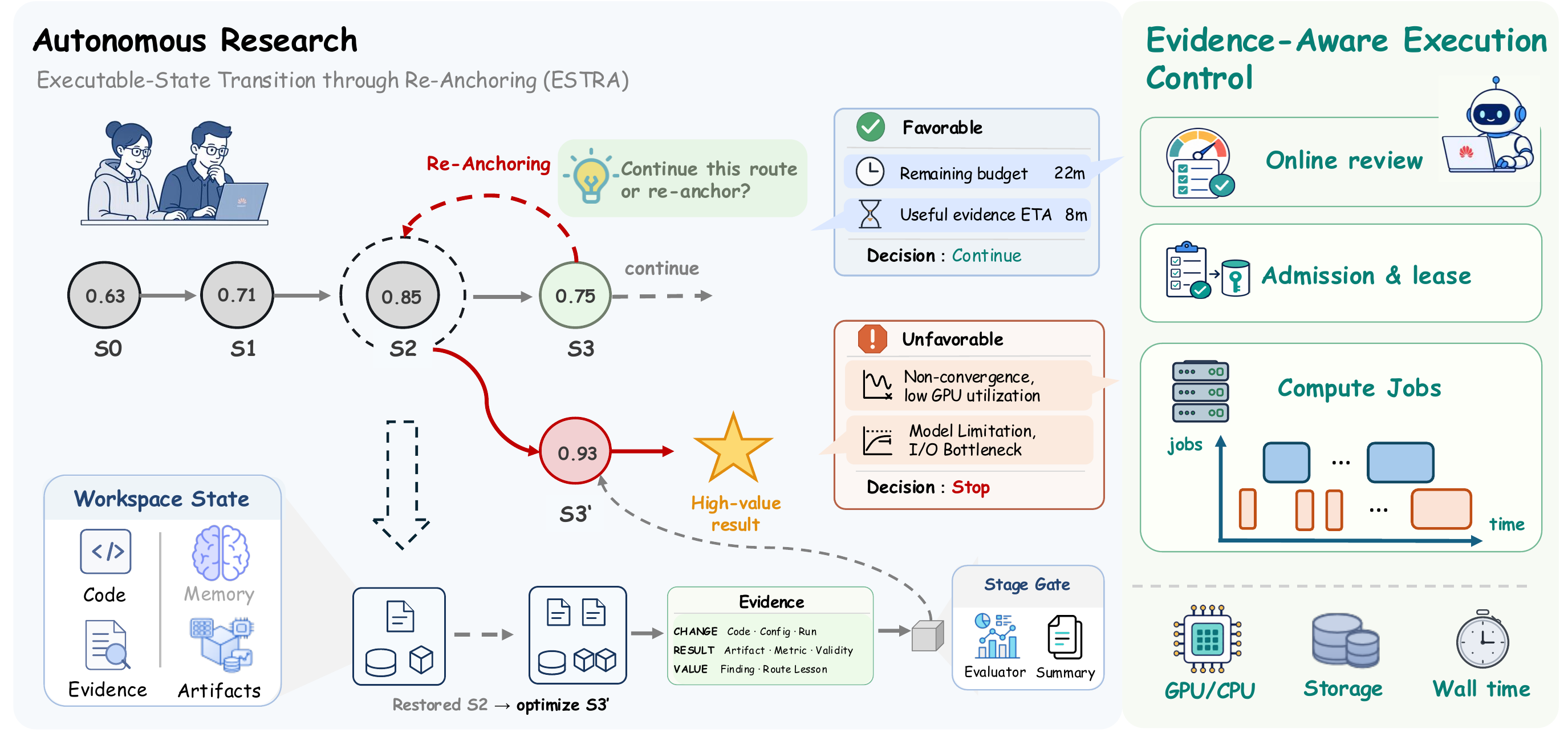
- Explore: isolated workers advance executable workspaces under explicit CPU, GPU, model, and time budgets.
- Evaluate: task evaluators convert artifacts into normalized evidence and final scores.
- Preserve: Stage Gate admits valid results as immutable, recoverable stages while the best artifact remains available independently of submission state.
- Adapt: ESTRA continues the current route or re-anchors work to a stronger archived stage at research boundaries.
Agent messages, reasoning, tool calls, evaluator results, resource samples, costs, and stage lineage are retained as structured events for inspection and future training workflows.
| You provide | ScienceFlow manages |
|---|---|
| Objective, constraints, and metric direction | Research lifecycle and parallel workers |
| Executable task code and required data | Isolated workspaces and resource leases |
| Evaluator and valid artifact contract | Evidence normalization and Stage admission |
| Baseline or starting implementation | Exploration, recovery, selection, and finalization |
A registered task.yaml is the source of truth for measurement and valid
artifacts. ScienceFlow does not invent a missing evaluator or silently replace required
task data.
Model settings stay local in ~/.config/scienceflow/models.json (mode
600); API keys are excluded from task manifests, sessions, and reports. See the
redacted example.
The base package provides the control plane and TUI. Install task-specific ML/GPU dependencies only when needed:
python -m pip install "scienceflow[full]"==0.2.0
CPU and GPU allocations form task boundaries; CPU capacity is divided across workers. Model
pricing is optional—without it, the UI reports Cost —. Do not resume a
workspace with a different task, dataset, evaluator, prompt, or artifact contract.
git clone --branch master https://github.com/science-learner/ScienceFlow.git
cd ScienceFlow
uv sync --python 3.12 --group dev
uv run scienceflow config init
uv run scienceflow tui
Use uv sync --extra full --group dev only when tests require the full ML/GPU
environment.
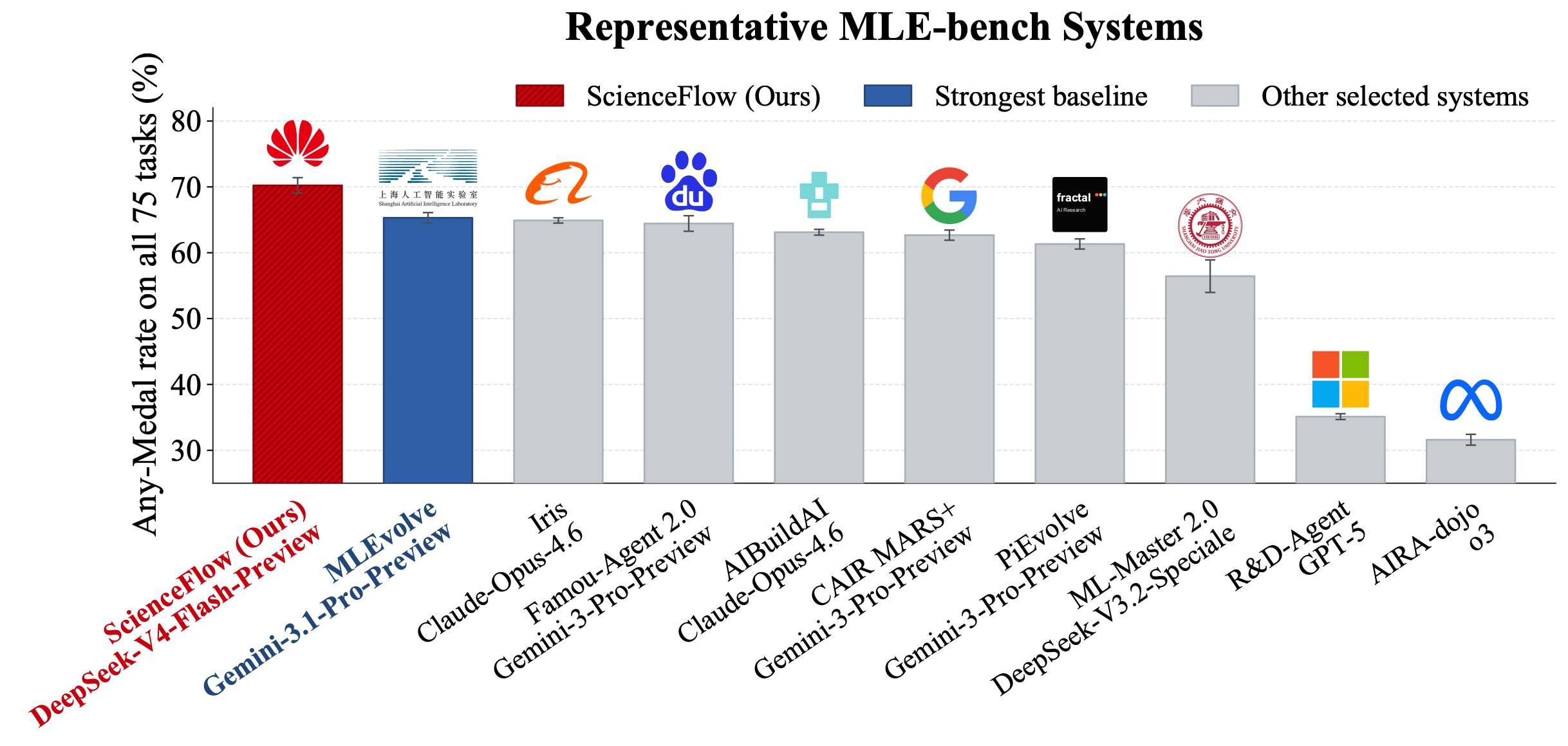
ScienceFlow uses the same Stage Gate and evaluator contract across machine-learning engineering, scientific modeling, and mathematical optimization. In the reported 24-hour, 75-task MLE-bench evaluation, it reaches 70.22 ± 1.18% Any-Medal over three runs.
If ScienceFlow supports your research, please cite:
@misc{zhao2026scienceflow,
  title         = {{ScienceFlow}: A Long-Horizon Agent for {ML} Research, Scientific Discovery and Beyond},
  author        = {Mingming Zhao and Jiqian Dong and Kangping Xu and Zadid Hasan and Chengrui Fan and Shan Jiang and Shuai Mao and Yating Ling and Linyi Zou and Tailin Zhou and Yun Hin Chan and Wenkai Zhang and Zhanhong Zhou and Guowei Huang and Hongliang Li and Wenjing Cun and Zhitang Chen and Mingxuan Yuan and Yanhui Geng},
  year          = {2026},
  eprint        = {2608.14354},
  archivePrefix = {arXiv},
  primaryClass  = {cs.AI},
  doi           = {10.48550/arXiv.2608.14354},
  url           = {https://arxiv.org/abs/2608.14354}
}