Observation-grounded benchmarks for scientific modeling and design agents.


Documentation · Architecture · API · Design-Bench Suite · Dataset Hub
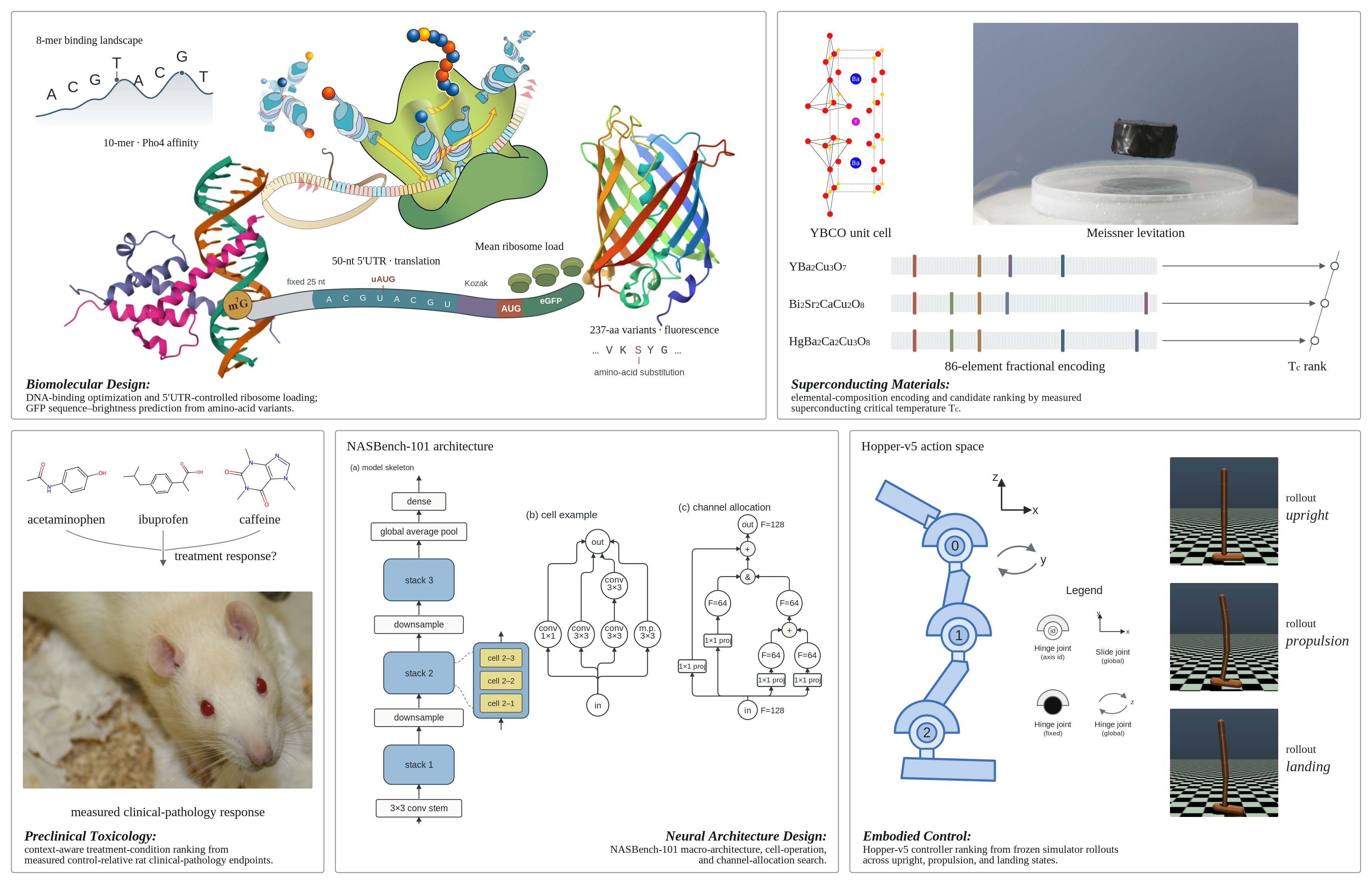
SciModelingBench separates versioned scientific observations, Agent-visible inputs, trusted target functions, and benchmark evaluation into explicit, reusable interfaces. The source tree includes end-to-end TFBind8, TFBind10 Pho4, Superconductor, CellDAG-NAS, Hopper Controller, UTR MRL, GFP, and DrugMatrix Tasks. The measured-pool integrations retain source observations and avoid treating legacy learned Design-Bench oracles as experimental truth.
SciModelingBench requires Python 3.10 or later.
Install the latest published version from PyPI:
python -m pip install sci-modeling-benchThe documentation below follows the current source tree:
python -m pip install \
"git+https://github.com/xukp20/sci-modeling-bench.git@main"SciModelingBench provides:
- revision-pinned loading of scientific datasets hosted on Hugging Face;
- semantic manifests, schemas, provenance metadata, and structured validation;
- trusted Objectives for persisted-target lookup or derived evaluation;
- integrity-checked local caching for deterministic derived evaluator artifacts;
- Protocols that construct the information exposed to an optimization agent;
- Tasks that bind Agent input to typed submission and metric semantics;
- optional, lazily loaded domain-knowledge resources.
The package does not define a universal submission format, query budgets, agent workflows, process isolation, or an evaluation harness.
Hub-backed Tasks enable derived artifact caching by default. Set
SCI_MODELING_BENCH_CACHE_DIR to choose a shared local root, call
task.prepare() before serving evaluations, or pass cache=False when no
persistent derived state is desired. Package upgrades reuse entries whenever
the pinned Dataset revision and derivation version are unchanged.
The package provides an end-to-end Task for the canonical TFBind8
SIX6_REF_R1 landscape. It combines the Design-Bench bottom-50% offline-data
Protocol, exact Objective, ordered submission contract, and common candidate
metrics:
from sci_modeling_bench.suites.design_bench import (
    TFBind8BlackBoxOptimizationTask,
)

task = TFBind8BlackBoxOptimizationTask.from_hub()
agent_input = task.build_input()
offline_data = agent_input.data

# A uniform, disclosure-scoped description of the visible table.
print(agent_input.manifest.model_dump_json(indent=2))

submission = [
    {"sequence": sequence}
    for sequence in offline_data["sequence"][:128]
]
evaluation = task.evaluate(submission)

print(evaluation.score)
print(evaluation.metrics)
print(evaluation.valid_candidates, evaluation.invalid_candidates)
When revision is omitted, the current default branch of the Dataset
repository is resolved to an immutable commit SHA for that Dataset instance.
For a reproducible benchmark run, pass a full commit SHA explicitly; the
initial TFBind8 release is
2ee2856f4255bb6a64c11b6c2660a6f41418e654.
The TFBind8 observations are downloaded from the public SciModelingBench Hugging Face organization and are not bundled in the Python wheel.
- Dataset binds immutable observations to metadata, semantic fields, validation rules, splits, and optional knowledge.
- Objective validates candidates and returns declared persisted or derived outputs while preserving batch order and repeated candidates.
- Protocol derives the data or context visible to an agent without modifying the underlying Dataset.
- Task defines one complete submission contract and its evaluation metrics; only Objective-backed Task subclasses require an Objective.
- Knowledge provides read-only explanatory resources pinned to the same dataset revision.
Dataset artifacts are hosted separately from this package. Neither the PyPI distribution nor the GitHub source repository bundles observation tables. Loaders resolve dedicated Hugging Face Dataset repositories at pinned commits; the package contains the framework, integrations, validators, and reproducible builders.
| Area | Entry point |
|---|---|
| Documentation | Documentation index |
| Architecture | Core concepts and data flow |
| Public interfaces | API overview |
| Implemented settings | Design-Bench suite |
| Evaluation | Candidate submission metrics |
| Changes | Changelog |
The public interfaces remain experimental. Pin package versions and Hugging Face revisions in reproducible runs. New releases are published only after the complete Dataset, Protocol, Objective, Task, documentation, and tests are validated together.